
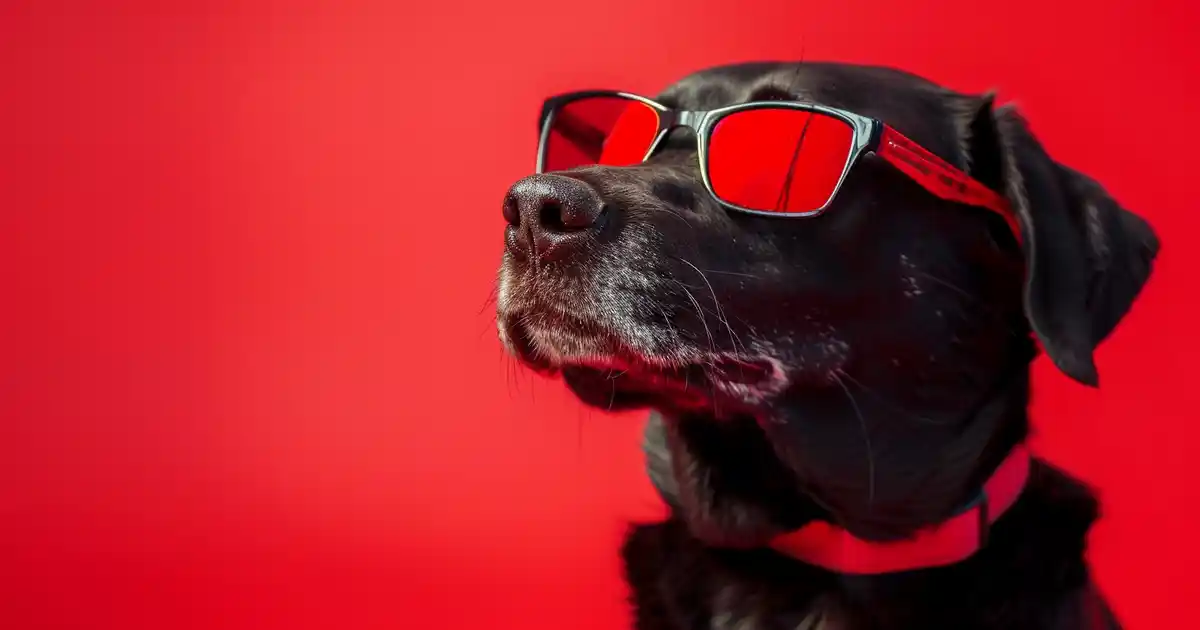
Have you ever tossed your dog a bright red ball across the green lawn and watched them run straight past it with an expression of genuine confusion that made you wonder whether you were somehow both playing the same game and completely different games at the same time? I had that exact moment of puzzled recognition with my dog Archie on a summer afternoon that started a months-long curiosity spiral about what the world actually looks like through his eyes — because the more I watched him struggle with certain toys in certain environments while navigating others with effortless confidence, the more I suspected that the popular explanation of dogs seeing in black and white was missing something important about what was actually happening. What I discovered through research that took me considerably deeper into comparative vision science than I originally anticipated was a story about red specifically that is more nuanced, more fascinating, and more practically useful than anything the simple colorblind shorthand captures — and if you have ever wondered what your dog actually perceives when they look at something red, whether that red toy is working against your dog in ways you never considered, or what the world genuinely looks like from behind those expressive eyes, this guide is going to give you the complete, honest, science-backed answer that transforms a casual curiosity into genuinely actionable knowledge.
Here’s the Thing About Dogs and Red
Here’s what makes red specifically such a revealing entry point into understanding canine color vision: of all the colors in the visible spectrum that humans experience, red is the one that undergoes the most dramatic transformation when perceived through a dichromatic visual system like a dog’s, shifting from the vivid, immediately attention-commanding wavelength that human trichromatic vision processes as distinctly red into something that falls within the yellow-to-brown-to-gray range of what dogs can actually discriminate — a perceptual transformation so complete that red objects can become functionally invisible against certain backgrounds that a human observer would consider obviously contrasting. According to research on dichromatic color vision, the visual system of dogs contains two types of cone photoreceptors — one sensitive to wavelengths in the blue-violet range and one sensitive to wavelengths in the yellow-green range — compared to the three cone types in the human visual system that allow discrimination across the full red-green-blue spectrum, and this difference means that the long-wavelength portion of the visible spectrum where red sits is processed not as a distinct color category but as a variation within the same perceptual range as yellows and browns, with no dedicated receptor type to signal its distinctiveness. What makes this understanding so practically significant rather than merely academically interesting is that red is also one of the most commonly used colors in dog toys, training equipment, agility gear, and pet products generally — a pervasive design choice driven entirely by human color preference and human visual experience that systematically works against the visual capabilities of the animals those products are designed for. I never fully appreciated the gap between my visual experience of red and Archie’s until I found a tool that simulated dichromatic vision and applied it to photographs of typical dog toy scenarios, and the invisibility of red objects against grass in those simulations was jarring enough that it permanently changed how I make every color-related decision for him. It is one of those pieces of knowledge that you cannot unlearn once you have genuinely understood it, and that quality of permanence is exactly what makes it worth understanding completely.
What You Need to Know — Let’s Break It Down
Understanding precisely why dogs cannot see red as a distinct color — not just the fact that they cannot but the specific biological mechanism that produces this outcome — is absolutely crucial because that mechanistic understanding is what allows you to apply the principle correctly in situations you have never specifically encountered rather than relying on memorized lists of which colors are or are not dog-appropriate. Don’t skip the cone photoreceptor fundamentals — color vision in any species depends on the brain comparing signals from different types of cone cells with different spectral sensitivities, and the perception of a specific color like red emerges not from a single cone type detecting red but from the ratio of activation between cone types, which is why having only two cone types rather than three fundamentally changes which distinctions the visual system can and cannot make. I finally connected this principle to practical toy color decisions when I understood that a dog looking at a red object receives essentially identical cone activation ratios as when looking at a yellow or brown object of similar brightness — the two types of cones available produce the same relative signal for red as they do for those other colors, giving the brain no basis for treating red as perceptually distinct. The specific perceptual appearance of red to dogs is not black, not gray, and not absent — it is a color within the yellow-to-brownish-yellow range of the dog’s accessible color space, with the exact shade depending on the brightness and saturation of the red object, meaning that a vivid saturated red appears as a medium yellow-brown while a darker red appears as a darker brownish tone and a very dark red appears as something approaching a dark gray. Green presents a similar challenge — dogs cannot distinguish red from green because both fall within the same region of their limited color space, which is why the red object disappearing into green grass is the quintessential example of canine color vision limitation in practice. Blue sits at the opposite end of the accessibility spectrum — dogs have a dedicated cone type sensitive to blue-violet wavelengths that has no analog in the rest of their color space, making blue genuinely vivid and distinctly perceived in ways that have no parallel in the red-green portion of the spectrum. For a comprehensive framework on how your dog’s complete sensory profile — vision, hearing, smell, and environmental perception — shapes their daily experience and how you can enrich that experience through informed choices, check out this helpful guide to understanding your dog’s sensory world for foundational context. Secondary concepts worth understanding clearly throughout this discussion include how the luminance contrast — the difference in brightness rather than color between an object and its background — partially compensates for color contrast limitations in dogs, why motion detection ability in dogs is superior to humans in ways that intersect with color vision limitations, and how individual variation in cone expression might produce minor differences in color perception between individual dogs even within the shared dichromatic framework.
The Science and Psychology Behind Why This Works
What research actually shows is that the peak spectral sensitivity of the two cone types in the dog’s visual system falls at approximately 429 nanometers for the short-wavelength cone — in the blue-violet range — and approximately 555 nanometers for the long-wavelength cone — in the yellow-green range — creating a visual system that is optimally sensitive to wavelengths between these peaks while losing discriminative ability at the longer wavelengths where orange and red sit, beyond the sensitivity range of either cone type in ways that produce the specific perceptual outcome of red being mapped into the yellow-brown region of dog color experience. Studies confirm that behavioral testing of canine color discrimination — presenting dogs with colored panels and rewarding selection of a target color to measure whether they can distinguish it from alternatives — demonstrates that dogs reliably distinguish blue from yellow, fail to reliably distinguish red from yellow or green, and show consistent performance patterns across individual dogs that confirm the dichromatic model rather than showing the variability you would expect if some dogs had additional cone sensitivity in the red range. Experts agree that the evolutionary logic behind the dog’s specific dichromatic configuration — with sensitivity concentrated in the blue and yellow-green ranges rather than the red-green range that is maximally useful for human fruit detection — reflects the ancestral ecological niche of canid predators operating most actively at dawn and dusk in environments where detecting moving prey against varied terrain mattered more than discriminating the color of fruit in forest canopy, and where the rod-dominant retinal design that provides superior motion detection and low-light sensitivity came at the cost of the cone density and diversity that supports fine color discrimination. Research from comparative vision scientists using electroretinography — direct measurement of retinal electrical responses to specific wavelengths — provides the most direct physiological confirmation of the dichromatic model, showing absent or negligible cone responses to wavelengths above approximately 620 nanometers in dogs, which is precisely the range where human red perception is most vivid and where the dog’s visual system essentially becomes insensitive. Understanding the specific neurophysiological basis of canine red-blindness is what allows you to be confident in applying this knowledge practically rather than treating it as an interesting theory that might not hold up in every situation.
Here’s How to Actually Make This Happen
Start your application of canine color vision knowledge with the most immediately impactful change available to most dog owners: a systematic review of your dog’s toy collection with the specific question of which toys are used primarily outdoors on grass or in variable natural environments, because those are the contexts where the red-disappears-into-green problem produces the most significant practical consequences for your dog’s experience. Here’s where I made the mistake that probably cost Archie and me months of suboptimal fetch sessions before I understood what was happening: I had built his toy collection entirely around what looked vibrant and appealing to me in the pet store display, gravitating toward the reds and oranges that the lighting and packaging made look exciting, without any awareness that I was selecting for visual categories that had zero relevance to Archie’s perceptual experience and significant negative relevance in grass environments. The practical application process that actually works begins with a three-category assessment of your existing toys. Toys that are blue or yellow regardless of their other characteristics are already working with your dog’s visual system rather than against it and can remain exactly as they are. Toys that are red, orange, or any shade in the red-to-orange-to-brown spectrum used primarily outdoors are the highest-priority replacement candidates — these are the toys that are most likely appearing as yellow-brown camouflaged against grass backgrounds from your dog’s perspective, making your dog work significantly harder than necessary to locate something you can see immediately. Toys in other colors including green, purple, or mixed colors require a case-by-case assessment of both their likely perceptual appearance in the dichromatic system and the specific background environments where they will be used. Now for the important part about how to choose replacement toys: the single most visually effective choice for outdoor use against grass backgrounds is a true, saturated blue — not a blue-green or teal that has significant green components but a clear, primary blue that sits solidly in the peak sensitivity range of the dog’s short-wavelength cone. Bright yellow is the second most effective choice and provides excellent visibility against darker backgrounds including wet grass, shaded areas, and dirt surfaces where blue might have lower contrast. Here’s my secret for maximizing Archie’s fetch success that goes beyond color alone — I now combine optimal color with maximum size and maximum motion, choosing toys large enough to provide good luminance contrast and throwing them in ways that keep them airborne as long as possible, because the combination of correct color, good size contrast, and prolonged motion takes advantage of all three of the dog’s strongest visual capabilities simultaneously rather than optimizing just one. This changes the toy selection process from roughly five minutes of choosing whatever looks appealing to roughly five minutes of choosing what works best for your dog, which is a trivial additional investment that pays off in measurably better play engagement every single session. Results from switching to blue and yellow outdoor toys are typically immediate and noticeably different in how quickly your dog locates the toy and returns to you — Archie’s fetch return time in open grass dropped dramatically after I switched his primary outdoor ball from red to blue, and the change was consistent enough across conditions that I am confident it was the color rather than coincidence.
Common Mistakes (And How I Made Them All)
The most persistent and widespread mistake in the dog toy industry and dog owner community alike is the conflation of what looks appealing to a human observer with what is visually effective for a canine user — a category error so deeply embedded in how pet products are designed and marketed that the majority of brightly colored dog toys in the typical pet store are colored primarily or entirely in the red-orange spectrum that is least visually accessible to dogs, and the justification for this is essentially never canine visual science but rather human aesthetic preference and human retail display psychology. Another mistake that I made for an embarrassing length of time is interpreting Archie’s success at eventually finding a red toy as evidence that the color was not a problem — the fact that dogs find red toys at all is not evidence that color is irrelevant but rather evidence that dogs have powerful compensatory capabilities including scent, sound, and motion detection that allow them to locate objects their visual system has not helped them find, and the time and effort involved in that compensatory search is the hidden cost of poor color choice that is invisible to the human observer who sees only the eventual success. Don’t make my mistake of assuming that all blue products are equivalent in their visual benefit to dogs — blue-green, teal, and cyan colors that blend blue and green components sit in a less clearly advantageous region of the dog’s color space than pure primary blue, and the marketing tendency to call many colors blue regardless of their precise wavelength composition means that reading color labels on toy packaging is not a reliable substitute for actually looking at the product and assessing whether the color is a true primary blue or a significantly diluted or shifted version. The mistake of applying color optimization insights only to toys while ignoring their relevance to training equipment, agility obstacles, retrieve dummies, and other items that dogs are expected to visually track and engage with in naturalistic environments represents a missed opportunity to apply a genuinely useful principle comprehensively rather than narrowly.
When Things Don’t Go as Planned
Feeling puzzled because you have switched to blue toys and your dog is still having trouble locating them in certain environments despite the color improvement? The issue is likely luminance contrast rather than color contrast — even a blue toy becomes difficult to locate if it is similar in brightness to the background it is placed against, and wet grass, deep shade, or certain soil colors can reduce the brightness contrast of even optimally colored toys below the threshold of easy detection. I have learned to address this by choosing toys that are not only the right color but also the maximum available brightness within that color — a vivid, saturated, light-value blue rather than a dark navy, and a bright, clean yellow rather than a gold or mustard — which combines color contrast and luminance contrast to create the maximum total visual signal against typical outdoor backgrounds. When this happens, don’t conclude that color optimization does not work — work through the specific environmental and lighting conditions where detection is failing and assess whether a brightness or size adjustment alongside the existing color improvement would address the remaining gap. If you have made color improvements to your dog’s toy collection and training equipment and are still seeing visual tracking problems that seem inconsistent with what you would expect even from a dichromatic visual system — your dog failing to notice moving objects at close range, bumping into familiar objects, showing reluctance to navigate in conditions they previously handled confidently — these observations warrant veterinary ophthalmological evaluation, because acquired vision changes including progressive retinal atrophy and other degenerative conditions can produce symptoms that are easily misattributed to color vision limitations when something more significant is actually occurring.
Advanced Strategies for Next-Level Results
Advanced application of canine color vision knowledge moves beyond toy selection into a comprehensive visual environment design philosophy that considers how color choices affect your dog’s experience across every domain of their daily life including training contexts, home environment navigation, outdoor adventure equipment, and competitive canine sports. One of the most practically significant advanced applications is the systematic color assessment of agility equipment — the contact zones, tunnel entries, jump wings, and weave pole bases that dogs are expected to navigate accurately under performance conditions where visual clarity directly affects speed, accuracy, and safety — with replacement of red, orange, and green elements with blue and yellow alternatives that provide genuine visual guidance rather than relying on the handler’s spatial direction and the dog’s spatial memory to compensate for visually ambiguous equipment. Experienced canine sports competitors who have implemented color optimization across their full equipment inventory consistently report improvements in initial obstacle targeting and contact zone accuracy for dogs new to the sport, suggesting that the visual clarity improvement is meaningful in training contexts where the dog is building spatial and visual associations for the first time rather than relying on well-established learned patterns. What separates the most sophisticated application of this knowledge from the basic toy-switching intervention is the habit of consistently asking the canine visual perspective question — not just for toys but for every visual element of your dog’s environment including the color of their food bowl against the floor, the visibility of their bed against the surrounding furniture, the contrast of training markers and target objects in the specific environments where training happens. For dog photographers interested in capturing images that reflect genuine canine visual engagement rather than human aesthetic preferences, understanding that blue and yellow elements in the frame will produce more natural, visually-directed dog attention and expression than red or green props is a practical application that produces meaningfully different and more authentic results.
Ways to Make This Your Own
When I want maximum visual engagement from Archie during high-distraction outdoor training where competing environmental stimuli are constantly drawing his attention away from training targets, I use what I call the Blue Signal Protocol — a specific bright blue target disc that I have used consistently enough that its color has become a conditioned attention cue, meaning the appearance of that specific blue object reliably orients Archie’s visual attention in my direction regardless of environmental distractions, taking advantage of both the genuine color visibility of blue in his visual system and the learned associative value of that specific target. For the budget-conscious owner who wants to implement color optimization without replacing an entire toy collection simultaneously, my Prioritize the Fetch Toy First approach focuses the initial investment on whichever single toy gets the most outdoor use in grass environments — typically the primary fetch ball or frisbee — since that is where the red-disappears-into-green problem has the highest daily impact and where the improvement from switching to blue will be most immediately and consistently noticeable. My seasonal color adaptation adjusts the specific color choices based on the dominant background color of the season — primary blue provides the strongest contrast against the green grass of spring and summer, while yellow provides better contrast against the brown, tan, and gray tones of dormant winter grass and bare ground, making seasonal toy rotation genuinely functional rather than merely cosmetic. Each approach works beautifully for different goals and different contexts. The Competitive Sports Adaptation for owners involved in agility, flyball, or disc competitions applies the color optimization principle systematically across all training equipment and competition preparation tools, treating canine visual optimization as a competitive training variable rather than a casual lifestyle choice.
Why This Approach Actually Works
Unlike the oversimplified colorblind narrative that leads people either to conclude that color does not matter for dogs and make all choices based on human preference, or to conclude that all colors are equally poor for dogs and that visual enrichment through color is impossible — both of which are wrong in consequential ways — this approach works because it builds on the actual biology of what dogs can and cannot perceive and uses that accurate biological foundation to make specific, predictable improvements in the visual effectiveness of the environments and objects you create for your dog. The sustainable element is that the core principle — dogs see blue and yellow but not red and green as distinct colors — is simple enough to remember and apply automatically to every color decision you make for your dog indefinitely, which means the benefit compounds over time as color optimization becomes a default consideration rather than a deliberate effort.
Real Success Stories (And What They Teach Us)
A flyball competitor I know had been working with her border collie on consistent box turn behavior for months with only moderate success, and on the recommendation of a canine sports colleague she replaced the red training marker at the box with a bright yellow one — the improvement in her dog’s targeting accuracy and consistency was immediate enough in the first session that she described it as one of the most surprising results she had ever seen from a single training change, and she subsequently replaced all red elements in her training setup with blue and yellow alternatives. Her success aligns with research on visual discrimination learning that shows consistent patterns — when the visual signal a learner is expected to use as a cue is genuinely accessible to their visual system, learning is faster, more consistent, and more resistant to environmental variation than when the learner must rely on compensatory strategies to overcome visual ambiguity. Another dog owner I know resolved a months-long mystery about why his vizsla performed flawlessly in indoor training environments but inconsistently in outdoor sessions by recognizing that the red training dummies he used for retrieve work were essentially camouflaged against the brownish grass of his training field in late summer — switching to yellow dummies produced an immediate and sustained improvement in outdoor retrieve reliability that the months of behavioral troubleshooting had never achieved. The lesson across both stories is a consistent and powerful one: when performance problems involve visual tracking, location, or discrimination in natural environments, the color of the visual target is a variable worth examining before attributing the inconsistency to motivation, distraction, or training gaps.
Tools and Resources That Actually Help
A dichromatic vision simulation app or online tool — several are freely available from veterinary vision researchers and comparative psychology departments — allows you to photograph any scene and view it through a simulated dichromatic filter, which produces a viscerally clear demonstration of exactly how dramatically red objects disappear against green backgrounds in dog vision and makes abstract color science immediately, personally meaningful in a way that text descriptions cannot match. A selection of toys specifically in primary blue and bright yellow stored as a dedicated outdoor toy kit — separate from indoor toys that may be in other colors — creates a frictionless default to visually optimized options for outdoor sessions without requiring any color deliberation in the moment. Bright flagging tape in blue or yellow is an inexpensive and versatile tool for marking training targets, retrieve points, and visual boundaries in outdoor environments, providing genuine color contrast for dogs at negligible cost and with complete flexibility for different training setups. A basic understanding of how to photograph toys against typical use backgrounds and apply a free dichromatic simulation filter takes about ten minutes to develop and allows you to evaluate any toy or equipment color before purchase, converting what is currently a post-purchase discovery process into a pre-purchase verification step. For comprehensive, rigorously sourced information on canine sensory biology including vision research with specific wavelength sensitivity data, the American Kennel Club’s science and health resources provide well-maintained, veterinarian-reviewed content that accurately represents the current scientific understanding of canine color vision without the oversimplification that characterizes most popular treatments of the subject. A simple personal commitment to the label-reading habit when purchasing any new dog product that involves color — asking whether the color serves the dog’s visual system or merely the human buyer’s aesthetic preference — is a zero-cost behavioral change that gradually converts your dog’s entire visual environment toward one that is genuinely optimized for how they actually see.
Questions People Always Ask Me
Can dogs see red at all, or is it completely invisible to them? Red is not invisible to dogs in the sense of being undetectable — it produces cone activation that the dog’s visual system processes into a perceptual experience. However, that perceptual experience falls within the yellow-to-brown range of the dog’s accessible color space rather than being processed as a distinct red category, meaning dogs cannot distinguish red from yellow or brown based on color alone. The practical consequence is that red objects lose their visual distinctiveness and can become very difficult to locate against backgrounds of similar brightness, particularly green grass where both the red object and the green background fall within the same undifferentiated yellow-brown region of dog color perception.
What does the color red actually look like to a dog? Based on the spectral sensitivity of canine cone photoreceptors and the principles of dichromatic color perception, red wavelengths produce a perceptual experience in dogs that falls somewhere in the yellow to brownish-yellow range, with the specific shade depending on the brightness and saturation of the red. A vivid, saturated red appears as a medium yellow-brown, a darker red appears as a darker brown, and a very dark red approaches the grayish end of the accessible range. There is no red category in dog color experience — the perceptual space simply does not contain a distinct region for long wavelength colors the way the trichromatic human visual system does.
Why do pet companies make so many red dog toys if dogs cannot see red? Red toys are designed for human buyers who make purchase decisions based on what looks vibrant and appealing in a retail environment — and red genuinely is vivid and attention-commanding in the trichromatic human visual system, making red toys look exciting and premium in store displays. The fact that this color choice systematically disadvantages the actual canine users of the products is not factored into most commercial toy design decisions because the buyer and the user are different individuals with different visual systems, and the buyer’s visual experience is the one that drives sales. This is a widespread design disconnect that improved consumer awareness is beginning to change as dog owners increasingly understand and apply canine vision science to their purchasing decisions.
Does it matter what color dog toys are for indoor use, or only outside? Color optimization matters most in outdoor use against natural backgrounds where red and green camouflage is most pronounced — indoor environments with light-colored floors provide some luminance contrast that partially compensates for poor color choice. However, even indoors, blue and yellow toys will be more visually distinct and easier to track than red or orange alternatives on most floor surfaces, and the principle of choosing colors within the dog’s accessible color space rather than outside it applies regardless of environment even if the outdoor performance benefit is most dramatic.
Can dogs learn to find a red toy through practice, and does that mean color does not matter? Dogs absolutely can and do learn to locate red toys through practice — they use scent, sound, spatial memory, and the eventual visual detection that occurs when proximity reduces the required visual acuity to locate even a poorly contrasting object. But the learning and searching process takes longer, requires more cognitive and sensory effort, and is more dependent on proximity and favorable lighting conditions than locating a blue or yellow toy of equivalent size. Practice compensates for poor color choice but does not eliminate the underlying perceptual limitation — it simply means the dog has developed more efficient compensatory strategies.
How does my dog see me — can they tell what color clothing I am wearing? Dogs perceive you primarily through a combination of shape, movement, and your overall luminance pattern rather than through specific clothing color. They will perceive blue clothing as distinctly blue and yellow clothing as distinctly yellow within their accessible color space, while red, orange, or green clothing will appear as variations of yellow-brown. For practical purposes this means that wearing blue or yellow in outdoor training environments where you want to be maximally visually distinct to your dog may provide a small additional visibility advantage, though your dog’s recognition of you depends far more on your overall shape, movement pattern, and scent than on clothing color.
Is there any difference between how male and female dogs see color? There is no documented sex-linked difference in canine color vision — unlike in humans where X-linked red-green color vision deficiencies are more common in males than females due to the chromosomal location of certain photopigment genes, the dichromatic configuration of canine vision appears consistent across sexes based on current comparative vision research.
Do dogs see better at night than humans, and how does this relate to their limited color vision? Yes, dogs have meaningfully superior low-light vision compared to humans, and this advantage is directly related to the same retinal design that limits their color discrimination. Dogs have a higher rod-to-cone ratio than humans — rods are far more sensitive to light than cones but provide only brightness information without color discrimination — and the tapetum lucidum, a reflective layer behind the dog’s retina absent in humans, amplifies available light by reflecting it back through the rod layer for a second opportunity for detection. The trade-off between rod density and cone diversity that gives dogs better night vision and motion detection at the cost of color range is one of the clearest examples of evolutionary visual optimization for a specific ecological niche.
Can I use red laser pointers with my dog since they cannot see red? A red laser pointer operating at typical consumer wavelengths would likely be within or near the edge of the dog’s visible range — some red laser wavelengths may be marginally detectable as a very dim stimulus while others may be below detectable threshold. More significantly, the behavior patterns associated with laser pointer use in dogs — the endless, compulsive pursuit of a target that can never be caught — create frustration and anxiety patterns that most veterinary behaviorists recommend avoiding regardless of the color. Blue or green laser pointers at appropriate power levels are sometimes used in canine enrichment contexts but with the same behavioral cautions about providing opportunities for physical reward and closure rather than endless unrewarded pursuit.
My dog seems to notice and respond to red traffic lights and red stop signs — how is that possible? Dogs likely respond to traffic lights based on position — learning that the top light means stop and the bottom means go — rather than based on color discrimination, which is a fascinating example of how dogs solve practical problems within their environment using spatial pattern recognition when color information is not reliably accessible. Stop signs may be recognized through their distinctive octagonal shape and placement pattern rather than their color. These examples illustrate how dogs develop effective environmental navigation strategies that do not depend on the color distinctions that humans rely on and may not even be aware they are using.
Should I buy a dog bed or crate mat in blue or yellow so my dog can find it more easily? The color of a dog bed or crate mat has minimal practical significance for a dog locating it, because dogs primarily locate their resting spots through spatial memory, scent, and the overall shape and texture of the item rather than through color-based visual search. The color optimization principle is most relevant in contexts where a dog needs to visually locate a specific object against a varied, complex background at distance — the retrieve toy in grass scenario — rather than in the context of returning to a familiar, scent-marked location in a known environment.
How does understanding canine red vision make me a better dog owner overall? Understanding that your dog’s visual experience of red is fundamentally different from yours — that the vivid, attention-commanding color you see becomes a yellow-brown camouflage tone in their visual system — produces a shift in perspective that extends beyond toy color selection into a more general habit of questioning your human-centric assumptions about your dog’s sensory experience. That questioning habit, applied consistently across visual design, training setup, environmental enrichment, and performance equipment choices, gradually builds a relationship with your dog that is grounded in their actual perceptual reality rather than in a projected version of your own, which is the foundation of genuinely empathetic and effective dog ownership.
Before You Get Started
I couldn’t resist putting together the most complete guide I could on this topic because the answer to whether dogs can see red is one of those pieces of knowledge that seems specific and narrow until you realize that it is actually a gateway into understanding the complete visual world of your dog in a way that makes you a more informed, more empathetic, and more effective partner in every aspect of your life together. The best outcomes for dogs always come from owners who understand their sensory reality accurately enough to make decisions that serve that reality rather than their own, and canine color vision is one of the most immediately applicable areas where that understanding produces tangible improvements you can observe directly. Ready to begin? Pick up your dog’s most-used outdoor toy right now, look at its color honestly, and ask yourself whether you chose it because it works for your dog’s visual system or because it looked appealing in the store — because that single question, asked consistently going forward, is the entire foundation of color-optimized dog ownership.




