
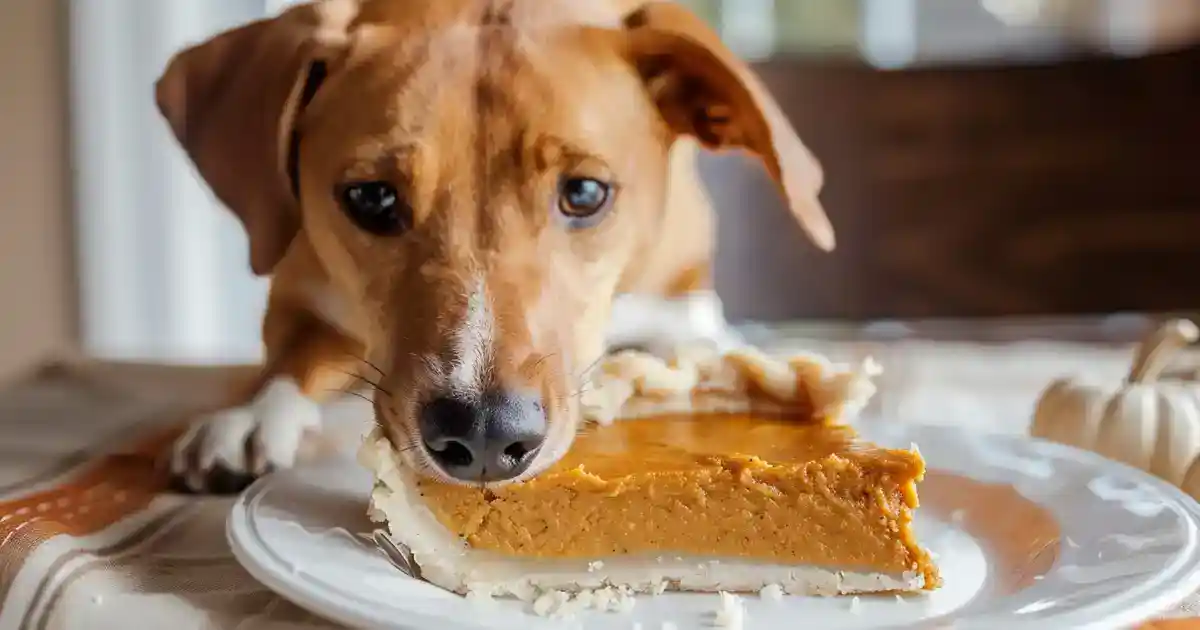
Have you ever been sitting at the Thanksgiving table with a slice of pumpkin pie in hand and looked down to find your dog staring up at you with that particular expression of hopeful longing that makes every holiday meal feel like a negotiation? I have been in that exact moment with my golden retriever Charlie, who has a talent for appearing at my elbow during every holiday meal looking simultaneously adorable and deeply convinced that whatever I am eating is obviously something he should be sharing. The question of whether dogs can eat pumpkin pie is one that comes up with remarkable consistency during the fall and holiday season, and the answer involves an important and potentially life-saving distinction that every dog owner needs to understand before passing a bite across the table. Plain pumpkin is actually one of the most genuinely beneficial foods you can offer your dog — but pumpkin pie is a completely different product whose ingredient list transforms a dog-beneficial food into a potentially toxic one through the spices and sweeteners added during preparation. If you have been wondering whether pumpkin pie is safe for dogs, which specific ingredients create the real dangers, or how to let your dog participate in holiday celebrations safely without the risk, this guide covers everything you need from someone who has navigated many holiday seasons with a treat-motivated golden retriever and learned exactly where the lines are.
Here’s the Thing About Pumpkin Pie and Dogs
Here is what makes pumpkin pie such an important topic to understand clearly rather than casually — the danger is not in the pumpkin itself, which is genuinely and substantially beneficial for dogs, but in the transformation that occurs when pumpkin becomes pumpkin pie through the addition of spices, sweeteners, and other ingredients that change its safety profile entirely. According to research on nutmeg toxicity, nutmeg contains myristicin, a compound that affects the central nervous system of dogs and can cause hallucinations, disorientation, increased heart rate, high blood pressure, dry mouth, abdominal pain, and seizures at sufficient doses — making it one of the most genuinely dangerous common spice ingredients in a typical kitchen from a canine safety perspective. What makes this genuinely life-changing information for dog owners is understanding that pumpkin pie spice blend — the aromatic mixture of cinnamon, nutmeg, ginger, cloves, and allspice that gives pumpkin pie its characteristic flavor — contains nutmeg as a standard ingredient in virtually every recipe, transforming what would otherwise be a beneficial pumpkin treat into a neurological risk for dogs. I never truly appreciated how dangerous nutmeg specifically was for dogs until Charlie showed intense interest in a pumpkin pie cooling on the counter one Thanksgiving and I started researching exactly what was in it before deciding how concerned to be — what I found completely changed how I think about holiday baking and dog safety in my kitchen. The sustainable approach to pumpkin pie and dogs is about understanding the specific ingredient-level risks rather than treating the dish as a single food item, which gives you both the clarity to protect your dog and the knowledge to create genuinely safe alternatives that let them participate in holiday celebrations without any risk.
What You Need to Know — Let’s Break It Down
Understanding the complete ingredient profile of pumpkin pie and what each component means for your dog is absolutely crucial before you can make informed decisions about sharing or managing accidental exposures, and don’t skip this section because the risk is distributed across multiple ingredients rather than residing in a single obvious hazard. Nutmeg is the most serious individual ingredient concern — even small amounts can cause toxic effects in dogs, and the threshold between an amount that causes mild symptoms and one that causes serious neurological effects is low enough that no amount of nutmeg should be considered safe for dogs. Cinnamon, the most prominent flavor in pumpkin pie spice, is not toxic to dogs in the way nutmeg is, but it can cause mouth and digestive irritation in larger amounts and the powdered form can irritate the respiratory tract if inhaled — it is the least concerning of the spice blend ingredients but contributes to the overall reason pumpkin pie spice is not appropriate for dog consumption. Cloves and allspice both contain eugenol, a compound that can cause liver toxicity in dogs at sufficient doses, adding another layer of concern to the spice blend beyond the nutmeg that anchors the danger. The sweetener component of pumpkin pie — whether standard granulated sugar or in some modern recipes xylitol as a sugar substitute — represents either a significant caloric and blood sugar concern or a life-threatening toxicity depending on which sweetener was used, with xylitol being among the most severely toxic substances a dog can consume causing rapid insulin release, severe hypoglycemia, and potentially fatal liver failure even in small amounts. (The xylitol risk in homemade and commercially prepared reduced-sugar pumpkin pie recipes is something most dog owners have not considered and it deserves serious attention any time a pie’s ingredient list is uncertain.) Don’t skip considering the pie crust and any dairy components like whipped cream or evaporated milk — the buttery high-fat pie crust contributes significant fat content that creates pancreatitis risk, and the dairy elements create lactose intolerance concerns for dogs who do not handle milk-based products well. I finally figured out after Charlie’s Thanksgiving counter incident that the safest approach to pumpkin pie in a dog household involves treating it as a multi-hazard item requiring active management rather than casual supervision. For practical guidance on creating dog-safe versions of holiday foods that let your dog participate in celebrations without any risk, check out this guide to safe homemade holiday treats for dogs for recipes that deliver the festive experience without the ingredient concerns. Yes, giving your dog a safe holiday treat experience they genuinely enjoy is completely achievable with the right recipes and ingredient knowledge.
The Science Behind Pumpkin Pie’s Dangers for Dogs
What research actually shows about the specific toxic mechanisms of the dangerous ingredients in pumpkin pie is both specific enough to understand the genuine risk and illuminating enough to explain why the same spices that are harmless to humans can cause serious harm in dogs. Studies confirm that myristicin, the primary toxic compound in nutmeg, affects the mammalian central nervous system through multiple pathways including its conversion to MMDA, an amphetamine-like compound, and through direct effects on monoamine oxidase inhibition — mechanisms that explain the range of neurological symptoms from disorientation and agitation at lower doses to seizures and potentially fatal cardiovascular effects at higher doses. The dose-dependent nature of nutmeg toxicity means that very small amounts may cause only mild symptoms while larger amounts can produce serious neurological crises, and because the nutmeg content of any given slice of pumpkin pie is not standardized and varies significantly by recipe, there is no reliably safe portion size that accounts for this variability. Research on eugenol toxicity in dogs, relevant to the cloves and allspice in pumpkin pie spice, demonstrates hepatotoxic effects at sufficient doses through mechanisms involving oxidative stress in liver cells, with cats showing greater sensitivity than dogs but dogs still being meaningfully more sensitive to eugenol than humans. The xylitol toxicity mechanism in dogs is among the most thoroughly documented food toxicities in veterinary medicine — xylitol causes rapid insulin secretion in dogs that does not occur in humans because of species differences in pancreatic response to xylitol, causing severe and potentially fatal hypoglycemia within thirty to sixty minutes of ingestion alongside the potential for delayed acute hepatic necrosis. According to the American Kennel Club’s toxicity resources, nutmeg is specifically identified as toxic to dogs and xylitol is identified as one of the most dangerous substances dogs can consume, both of which appear in or can appear in pumpkin pie as standard or substitute ingredients. Understanding this science transformed my approach from general caution about holiday food sharing to specific and absolute protocols around pumpkin pie and any food containing these ingredients.
Here’s How to Actually Protect Your Dog During Holiday Pumpkin Season
Start by building a clear and absolute mental rule about pumpkin pie specifically — unlike the nuanced portion-based guidance appropriate for many human foods, pumpkin pie should not be shared with dogs in any amount because the multi-ingredient hazard it represents does not become safe in small quantities when nutmeg and potentially xylitol are part of the recipe. Don’t be me before Charlie’s counter incident, operating on the casual logic that a small bite of a food containing pumpkin could not be particularly harmful without examining what else was in it — the gap between plain pumpkin which is beneficial and pumpkin pie which contains toxic spices is precisely the kind of category error that causes dog owners to make sharing decisions they later deeply regret. The practical protection protocol for holiday pumpkin season involves keeping pumpkin pies on high surfaces inaccessible to your dog, never leaving a cooling pie unattended at counter level with a food-motivated dog in the house, disposing of pie scraps and plates directly into covered trash rather than leaving them at accessible levels, and communicating clearly to holiday guests that pumpkin pie is not a safe treat to share with your dog regardless of how convincingly your dog performs their best hopeful stare. Here is the approach that has worked for every holiday since Charlie’s counter incident — pies cool on top of the refrigerator rather than on the counter, dessert plates go directly from the table to the kitchen sink rather than being set on the floor or coffee table, and guests are given a bag of Charlie’s safe pumpkin treats at the start of the meal so that the impulse to share something with him has a safe outlet that does not require anyone to make a food safety assessment in the middle of a festive gathering. Results of this approach are completely reliable because they depend on environmental management rather than Charlie’s self-restraint, which is not something I have ever successfully cultivated around golden retriever food motivation.
Common Mistakes — And How I Made Them All
My mistakes around pumpkin pie and dog safety were entirely predictable and I share them without reservation because every single one is an error I see repeated by caring and attentive dog owners who simply have not encountered the specific information about nutmeg toxicity and pumpkin pie’s ingredient profile before. My biggest mistake was the foundational category error of thinking pumpkin pie was essentially pumpkin with some spices added, rather than recognizing it as a multi-ingredient product where specific components create toxicity entirely separate from the base pumpkin ingredient. Don’t make my mistake of allowing the name and main ingredient of a food to represent its complete safety profile when the actual risk resides in supporting ingredients. My second major error was not realizing that the small jar of pumpkin pie spice sitting in my spice cabinet — which Charlie had shown no interest in — was the same spice blend that made the pumpkin pie on the counter dangerous, which meant I had been using it in other baked goods without thinking about whether any of those were being shared with Charlie in ways I had not fully tracked. The third mistake I made was not communicating clearly to family members about the pumpkin pie situation at the first holiday after I learned about it, which resulted in a well-meaning family member offering Charlie what they described as just a tiny bit of pie crust because surely the crust itself was fine — the crust contained butter, sugar, and in this particular homemade recipe a dusting of pumpkin pie spice on top that made even the crust a nutmeg exposure concern. Another significant error was not preparing a supply of safe pumpkin treats for Charlie before holiday gatherings, which meant that when guests wanted to include him in the celebration there was nothing appropriate available and the temptation to share from the actual holiday food was higher than it needed to be.
When Things Don’t Go as Planned
Feeling panicked because your dog just ate pumpkin pie or you suspect they did? The urgency of your response should be calibrated to what was in the pie and how much was consumed, and I have a clear framework for making this assessment that has guided me through several Charlie kitchen incidents. The most critical variable is whether nutmeg was in the recipe and how much the pie contained, followed immediately by whether the recipe used xylitol as a sweetener — if xylitol was present in any amount, call the ASPCA Animal Poison Control Center at 888-426-4435 immediately without waiting to see if symptoms develop because xylitol toxicity can progress extremely rapidly and early intervention is critical for outcome. Don’t wait for symptoms when xylitol exposure is possible or confirmed — the hypoglycemia that xylitol causes can become severe within thirty to sixty minutes and the window for the most effective intervention is narrow. For pumpkin pie containing standard sugar rather than xylitol, the primary concern becomes the nutmeg and spice blend content — a small amount of pie consumed by a large dog may produce only mild gastrointestinal symptoms, while a larger amount or a small dog warrants prompt veterinary contact regardless of whether symptoms are yet apparent. When symptoms of nutmeg toxicity appear including disorientation, agitation, rapid heart rate, wobbling, or extreme lethargy, these represent a veterinary emergency that requires immediate professional intervention rather than home monitoring. I always prepare for holiday food incidents by having poison control numbers saved and knowing Charlie’s current weight because these are the two pieces of information any poison control consultation requires immediately and having them without searching saves critical minutes.
Advanced Strategies for Next-Level Holiday Safety
Once the immediate pumpkin pie safety knowledge is firmly established, there are more sophisticated household management approaches that experienced dog owners use to create genuinely comprehensive protection across all the holiday food scenarios that create risk beyond just the pumpkin pie itself. One advanced strategy is doing a holiday-specific kitchen hazard audit before major cooking and baking events — identifying all the ingredients in your planned holiday recipes that create canine toxicity risk including nutmeg, xylitol, xylitol-containing peanut butter brands, raisins in stuffing, onion and garlic in savory dishes, and grapes — and building specific management protocols for each before the cooking begins rather than improvising during the distraction of active holiday preparation. Another technique that experienced holiday hosts with dogs use is creating a designated dog safety zone — an area of the home with a comfortable bed, enrichment toys, and safe treats where the dog can be settled during the highest-risk periods of holiday food preparation and serving without requiring constant supervision or exclusion from the family celebration entirely. For households where multiple family members and guests are involved in holiday gatherings, a brief and friendly communication at the start of the event — something as simple as saying the dog has their own special treats on the table for guests to share — simultaneously provides guests with a safe sharing option, removes the temptation to offer holiday food, and prevents the well-meaning but uninformed sharing that is responsible for a significant proportion of holiday food toxicity incidents in family dogs.
Ways to Make This Your Own
When I want Charlie to have the most genuinely festive holiday treat experience possible without any risk, I use what I call the Safe Pumpkin Celebration Protocol — making a batch of plain canned pumpkin treats in the days before any holiday gathering using nothing but plain pumpkin puree, oat flour, and an egg baked into simple dog cookies that I package in a small holiday-themed bag and leave on the table as the official dog-treat option for guests who want to include Charlie in the celebration. For busy dog owners who want the simplest possible safe alternative without any baking, a spoonful of plain canned pumpkin puree — not pumpkin pie filling, which contains spices and sweeteners, but plain single-ingredient pumpkin — served in Charlie’s bowl alongside the family’s holiday meal provides the festive pumpkin experience with every genuine nutritional benefit and zero risk. My approach for households where multiple dogs of different sizes are present at holiday gatherings focuses on pre-portioning safe treats in individual labeled bags before guests arrive, which prevents the free-for-all sharing dynamic that makes accurate portion tracking impossible and ensures each dog gets an appropriate amount for their size. For dog owners who enjoy baking for their pets, the holiday season provides an excellent opportunity to develop a signature safe dog treat recipe using plain pumpkin as the base ingredient alongside dog-safe additions like peanut butter without xylitol, oats, and banana — creating a treat tradition that becomes as much a part of the holiday as the human desserts without any of the ingredient concerns. Each variation of safe pumpkin celebration works beautifully for different households and holiday styles, and any intentional safe alternative is infinitely better than hoping no one slips the dog a bite of actual pie.
Why This Approach to Holiday Dog Safety Actually Works
Unlike the general holiday food caution advice that tells dog owners to keep their dog away from the table without explaining specifically what the risks are and why, this ingredient-specific and protocol-based framework gives you both the understanding of exactly what makes pumpkin pie dangerous and the concrete management strategies that address every scenario where holiday pumpkin food creates risk. What makes this genuinely different from general holiday safety reminders is that it identifies the specific toxic compounds in pumpkin pie’s ingredient profile — nutmeg’s myristicin, spice blend eugenols, and the critical xylitol variable — explains their mechanisms in ways that make the danger feel real and proportionate rather than abstract, and provides both prevention protocols and emergency response frameworks calibrated to different exposure scenarios. The evidence-based components of this approach including nutmeg toxicity science, xylitol emergency response protocols, multi-ingredient hazard awareness, and safe alternative creation are each grounded in veterinary toxicology and practical household management rather than general holiday caution. I discovered through Charlie’s holiday adventures and the research they prompted that the dog owners who navigate holiday seasons without food toxicity incidents are almost always the ones who have developed specific rather than general knowledge about holiday food hazards and translated that knowledge into specific environmental management and communication protocols rather than relying on in-the-moment supervision during the inherently distracting atmosphere of a holiday gathering. This approach is sustainable because it creates holiday traditions around safe sharing rather than anxiety around unsafe sharing, which makes the experience genuinely better for both the dogs and their owners.
Real Success Stories — And What They Teach Us
A friend of mine, Sandra, had a miniature schnauzer named Pretzel who consumed a meaningful portion of pumpkin pie that a holiday guest had set on the coffee table assuming it was out of reach for a small dog — a miscalculation that schnauzers in particular are well-equipped to correct. Because Sandra had recently learned about nutmeg toxicity in dogs and knew immediately that pumpkin pie was a concerning exposure rather than a harmless holiday food sharing moment, she called her vet within minutes of discovering what had happened and Pretzel received prompt supportive care that addressed his developing symptoms before they became severe. His recovery was complete, and Sandra describes the outcome as the direct result of knowing what was dangerous and responding to that knowledge immediately rather than waiting to see how serious the situation would become. Her story illustrates exactly how specific ingredient knowledge converts a potentially serious incident into a managed one through prompt and informed response. Another dog owner I know, Rebecca, had been sharing small amounts of pumpkin-flavored foods with her labrador Winston throughout autumn without incident until she made a homemade pumpkin pie with a recipe that specifically called for a full teaspoon of nutmeg and Winston consumed a significant slice from an unattended plate. The severity of his reaction was markedly greater than anything she had seen from previous pumpkin food exposures and required emergency veterinary care — an outcome that clearly illustrated the difference between pumpkin-flavored products with negligible nutmeg and a traditional pumpkin pie recipe with a full nutmeg inclusion. Their experiences with pumpkin pie and dogs illustrate the consistent lesson of this guide — that ingredient-specific rather than category-level food safety knowledge is what makes the difference between incidents that are managed safely and incidents that become emergencies.
Tools and Resources That Actually Help
The single most practically valuable preparation for holiday pumpkin season in a dog household is having the ASPCA Animal Poison Control Center number — 888-426-4435 — saved in your phone and having your veterinarian’s emergency number equally accessible, because the response window for xylitol toxicity in particular is narrow enough that having these numbers require a search rather than an immediate dial represents a meaningful and potentially consequential delay. A supply of plain canned pumpkin puree kept specifically for dog treat preparation — not pumpkin pie filling which already contains spices and sweeteners, but plain single-ingredient pumpkin — is the most versatile and universally safe pumpkin product to have available and costs about two dollars per can, providing the base for countless safe treat options. For owners who want to bake safe holiday dog treats, silicone treat molds in seasonal shapes create festive dog cookies that look genuinely celebratory without requiring any ingredients that create safety concerns, and they cost five to fifteen dollars for a set that lasts indefinitely. Understanding the complete list of holiday foods that create canine toxicity risk beyond pumpkin pie — including grapes and raisins in stuffing and fruit dishes, onion and garlic in savory preparations, xylitol in sugar-free desserts, chocolate in all its holiday forms, and macadamia nuts in cookies and dishes — builds the comprehensive holiday food awareness that protects against the full range of seasonal hazards. The ASPCA Animal Poison Control database provides the most comprehensive and regularly updated resource on food and plant toxicity for dogs that exists, and spending thirty minutes reviewing the holiday food section before the season begins is one of the most valuable preventive investments a dog owner can make.
Questions People Always Ask Me
Can dogs eat pumpkin pie safely? No — pumpkin pie should not be given to dogs because the spice blend used in virtually every pumpkin pie recipe contains nutmeg, which is toxic to dogs and can cause neurological symptoms including disorientation, agitation, rapid heart rate, and seizures at sufficient doses. Additionally, pumpkin pie may contain xylitol as a sweetener in some recipes, which is severely toxic to dogs and requires emergency veterinary intervention. The pumpkin base ingredient is safe, but the complete pie is not.
What ingredient in pumpkin pie is most dangerous for dogs? Nutmeg is the most dangerous standard ingredient in pumpkin pie for dogs due to its myristicin content which affects the central nervous system. If xylitol is used as a sweetener in the recipe rather than standard sugar, xylitol becomes the most urgently dangerous ingredient because of its ability to cause life-threatening hypoglycemia and liver failure even in small amounts. Both ingredients warrant immediate veterinary attention if consumed.
Can dogs eat pumpkin pie filling from a can? Canned pumpkin pie filling should not be given to dogs because it already contains the spices and sweeteners that make pumpkin pie dangerous — including nutmeg and significant added sugar. Plain canned pumpkin puree with no additives is completely different from pumpkin pie filling and is safe and beneficial for dogs. Always check whether the can says plain pumpkin or pumpkin pie filling before sharing any canned pumpkin product with your dog.
What should I do if my dog ate pumpkin pie? Call your veterinarian or the ASPCA Animal Poison Control Center at 888-426-4435 immediately if you know or suspect xylitol was in the recipe — do not wait for symptoms. For pumpkin pie made with standard sugar rather than xylitol, assess the amount consumed and your dog’s size — small exposures in large healthy dogs warrant monitoring for symptoms, while larger exposures or any exposure in small dogs warrants prompt veterinary contact. Symptoms of nutmeg toxicity including disorientation, rapid heart rate, or neurological signs require emergency veterinary care.
Is pumpkin pie spice toxic to dogs? Yes — pumpkin pie spice blend contains nutmeg as a standard ingredient alongside cinnamon, ginger, cloves, and allspice. Nutmeg is toxic to dogs and the cloves and allspice contain eugenol which can cause liver toxicity at sufficient doses. Pumpkin pie spice should never be offered to dogs and any food containing it should be treated as a dog hazard rather than a safe sharing option.
Can dogs eat the pumpkin pie crust? Pie crust should not be offered to dogs — it contains high fat content from butter that creates pancreatitis risk, significant sugar content, and in some recipes a dusting of pumpkin pie spice that brings the nutmeg concern into the crust itself. Even setting aside the spice issue, the high fat and sugar content of pie crust makes it an inappropriate food for dogs rather than an acceptable alternative to the pie filling.
Is plain pumpkin safe for dogs? Yes — plain pumpkin is one of the most genuinely beneficial foods you can offer dogs. Plain canned pumpkin puree is rich in fiber that supports digestive health, beta-carotene for immune and eye health, and vitamins including vitamin C and potassium. It is commonly recommended by veterinarians for managing both diarrhea and constipation in dogs. The key is ensuring the product is plain pumpkin puree with no additives rather than pumpkin pie filling which contains spices and sweeteners.
How much nutmeg is dangerous for dogs? The precise toxic dose of nutmeg for dogs is not definitively standardized in veterinary literature because it varies based on the individual dog’s size, health status, and the specific form of nutmeg consumed. Even small amounts of nutmeg have been documented to cause toxic effects in dogs, which is why no amount of nutmeg should be considered safe for dogs and why pumpkin pie — whose nutmeg content varies by recipe — should simply not be offered to dogs rather than offered in calculated small amounts.
Can dogs eat whipped cream on pumpkin pie? Plain whipped cream without sweeteners is not acutely toxic to dogs, but it contains lactose that many adult dogs cannot digest well and fat content that contributes to digestive upset and pancreatitis risk with regular consumption. A small amount of plain whipped cream is unlikely to cause serious harm in a healthy dog, but it is not a safe sharing option from pumpkin pie specifically because it comes in contact with the nutmeg-containing filling and may pick up trace amounts of the spiced surface.
How do I make a dog-safe pumpkin treat for the holidays? The simplest dog-safe pumpkin treat is a spoonful of plain canned pumpkin puree served in your dog’s bowl during the holiday meal — no preparation needed, completely safe, and genuinely nutritionally beneficial. For a more festive option, mix plain pumpkin puree with oat flour, peanut butter confirmed to contain no xylitol, and an egg, roll and cut into shapes, and bake at 350 degrees for twenty minutes. These treats deliver every benefit of pumpkin with no ingredient concerns and can be shared freely with your dog and your holiday guests.
Is pumpkin pie dangerous for dogs even in small amounts? Because nutmeg toxicity is dose-dependent but has no established safe threshold for dogs, and because the nutmeg content varies significantly by recipe, there is no reliably safe small amount of pumpkin pie that accounts for the variability in recipe nutmeg concentration. A very small bite of a lightly spiced pie in a large dog is unlikely to cause serious harm, but the appropriate guidance is to avoid pumpkin pie entirely rather than to calculate safe portions, because the safe portion depends on recipe-specific nutmeg content that you cannot know with certainty.
Can dogs eat other pumpkin-flavored foods safely? It depends entirely on the ingredients. Pumpkin-flavored foods that are made with plain pumpkin and dog-safe sweeteners without pumpkin pie spice blend are generally safe. Pumpkin-flavored foods made with pumpkin pie spice which contains nutmeg are not safe. Reading the complete ingredient list of any pumpkin-flavored food rather than relying on the flavor description is the essential habit for making these assessments correctly.
One Last Thing Before You Go
I couldn’t resist putting together this complete guide because the information about pumpkin pie and dogs is exactly the kind of specific, ingredient-level knowledge that stands between a wonderful holiday gathering and a veterinary emergency — and it is knowledge that most dog owners do not encounter until they need it rather than before. The best holiday seasons with dogs happen when owners understand that plain pumpkin and pumpkin pie are entirely different products with entirely different safety profiles, build the environmental management habits that prevent access to genuinely dangerous holiday foods, and create safe treat alternatives that let dogs participate in celebrations without any risk. Start with one specific action today — making a note of the ASPCA Poison Control number, buying a can of plain pumpkin for safe holiday treats, or simply committing to the absolute rule that pumpkin pie never goes to Charlie regardless of the holiday hopeful stare — and let that one informed decision make this holiday season safer and more joyful for every member of your family including the four-legged ones.




