
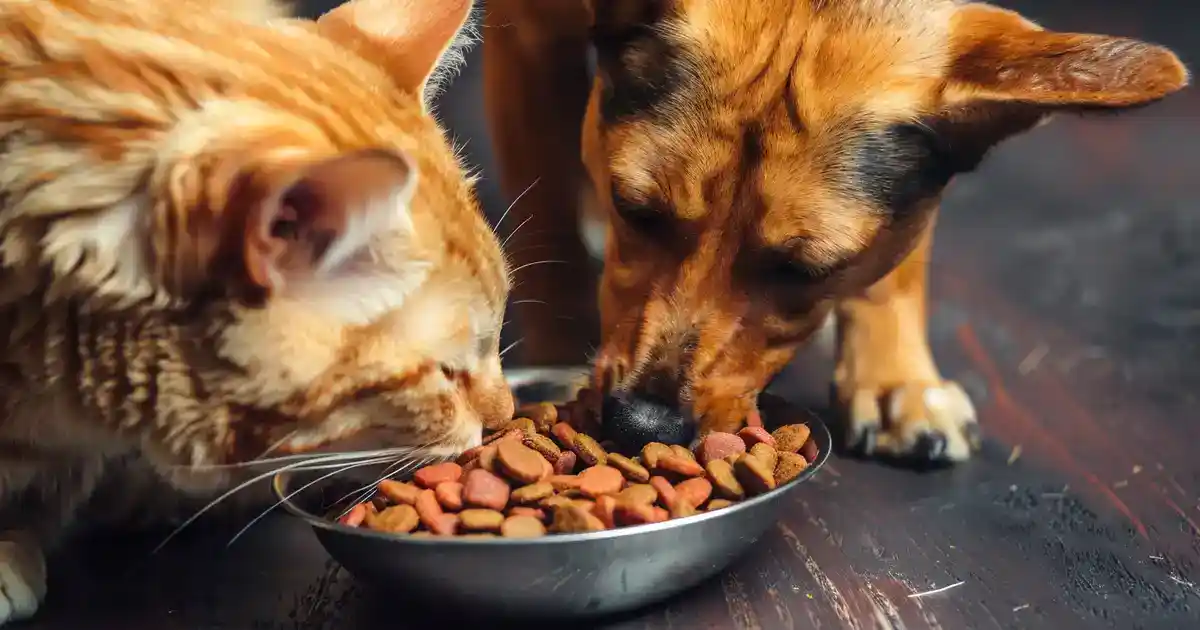
Have you ever turned your back for thirty seconds in a multi-pet household only to discover your dog has completely demolished your cat’s food bowl with the focused enthusiasm of someone who has been planning this heist for weeks? I have lived this scenario more times than I can count with my beagle Rosie, who treats my cat Miso’s food bowl as the most forbidden and therefore most desirable thing in the entire house. The question of whether cat food can harm dogs is one that comes up constantly in multi-pet households, and the answer is genuinely more nuanced than a simple yes or no in ways that matter enormously for your dog’s long-term health. If you have been wondering whether dogs eating cat food is a serious concern, what actually happens when a dog regularly sneaks cat food, or how to manage a household where two very different species have very different nutritional needs, this guide covers everything you need to know from someone who has navigated all of it firsthand.
Here’s the Thing About Dogs and Cat Food
Here is what makes the cat food question so important and so frequently misunderstood — the occasional stolen mouthful from your cat’s bowl is a very different situation from regular or sustained cat food consumption, and understanding that distinction is what separates a minor household management issue from a genuine long-term health concern. According to research on cat nutrition, cats are obligate carnivores with dramatically different nutritional requirements than dogs, and cat food is specifically formulated to meet those unique feline needs — which means it is nutritionally mismatched for dogs in ways that become meaningful over time. What makes this genuinely life-changing information for multi-pet owners is understanding that cat food is not simply dog food with different branding — it contains significantly higher levels of protein and fat, different amino acid profiles including much higher taurine concentrations, and caloric densities that are calibrated for a cat’s metabolism rather than a dog’s. I never truly grasped how differently these two species process nutrition until Rosie developed persistent digestive upset that my vet traced directly back to her successful and sustained campaign to eat Miso’s food every single day for two months. The sustainable approach to this situation is about understanding the real nutritional differences rather than panicking about every stolen kibble, and it is honestly more manageable than it sounds once you have the right information.
What You Need to Know — Let’s Break It Down
Understanding the core nutritional differences between cat food and dog food is absolutely crucial before anything else, and don’t skip this section because the specifics genuinely determine how concerned you need to be about your individual situation. Cat food is formulated with an obligate carnivore’s needs in mind — dramatically higher protein content typically ranging from thirty to fifty percent compared to dog food’s eighteen to twenty-six percent, much higher fat content, and specific nutrients like arachidonic acid and preformed vitamin A that cats cannot synthesize themselves and must obtain from their diet. Dogs, as omnivores, have very different nutritional requirements and metabolic pathways, and consistently eating food calibrated for a different species creates imbalances that accumulate over time rather than causing immediate dramatic symptoms. (This slow accumulation is exactly what makes it so easy to miss — Rosie seemed completely fine for weeks before the digestive issues emerged.) Understanding that the high protein and fat content in cat food is the primary driver of health concerns in dogs helps clarify why occasional exposure is genuinely different from regular consumption. Don’t skip considering your dog’s individual health profile when assessing risk — a healthy young dog with no pre-existing conditions handles occasional cat food exposure very differently than a senior dog, an overweight dog, or a dog with known kidney or liver sensitivities. I finally figured out after Rosie’s digestive incident that the single most effective thing I could do was simply manage access rather than trying to teach a beagle that food theft is morally wrong, which was always going to be a losing battle. If you want practical guidance on building a nutritionally complete diet for your dog that meets all their actual needs so they are less obsessively drawn to other food sources, check out this complete guide to balanced homemade dog food for evidence-based strategies that support your dog’s health from the ground up. Yes, meeting your dog’s nutritional needs properly genuinely reduces the frantic food-seeking behavior that makes cat food so irresistible to so many dogs.
The Science Behind Why Cat Food Affects Dogs Differently
What research actually shows about the effects of cat food on dogs is both reassuring for occasional exposures and genuinely concerning for regular consumption patterns. Studies confirm that the protein and fat concentrations in cat food create a significantly higher caloric load per serving than equivalent volumes of dog food, which means a dog eating cat food regularly is consuming substantially more calories than their nutritional guidelines account for — creating a direct pathway to obesity and all its associated secondary health concerns including joint stress, diabetes risk, and cardiovascular strain. Experts agree that the high protein load from sustained cat food consumption places additional demands on a dog’s kidneys and liver, organs responsible for processing and excreting the metabolic byproducts of protein digestion, and that dogs with any pre-existing renal or hepatic compromise face meaningfully elevated risk from regular cat food exposure. The fat content in cat food is also worth understanding from a clinical perspective — dietary fat is the most calorie-dense macronutrient, and consistently elevated fat intake in dogs is one of the most significant dietary triggers for pancreatitis, a painful and potentially serious inflammatory condition of the pancreas that requires veterinary treatment. According to the American Kennel Club’s nutrition resources, while a dog eating cat food occasionally is unlikely to experience serious harm, the cumulative effects of regular consumption make it an important household management issue rather than a minor concern. Understanding this science completely changed how seriously I took Rosie’s cat food raids and how much effort I put into the management solutions that actually stopped them.
Here’s How to Actually Manage a Multi-Pet Household With Dogs and Cats
Start with the single most effective intervention available, which is feeding your cat in a location your dog physically cannot access — this was the solution that finally worked for us after months of less reliable attempts and it is honestly the most important step in this entire guide. Don’t be me in the early days trying to train Rosie away from Miso’s bowl through willpower and verbal corrections, because asking a food-motivated beagle to voluntarily ignore a bowl of high-fat, high-protein food sitting on the floor is asking for failure. The practical solutions that actually work involve architecture rather than discipline — feeding your cat on a surface your dog cannot reach, installing a cat door into a room where your dog cannot follow, or using a feeder with a microchip-activated door that opens only for your cat’s chip. Here is the solution that transformed our household: I feed Miso on top of the washing machine in the laundry room with the door held slightly ajar by a door stop sized for a cat but not a beagle, which cost nothing and solved the problem completely within one day. Now for the important part — if your dog has already eaten cat food and you are assessing the aftermath, the key variables are how much they ate and how regularly. A single stolen mouthful from a healthy dog warrants observation but not panic. A dog who has been eating significant quantities of cat food daily for weeks warrants a vet conversation, particularly if they are showing digestive symptoms, gaining weight, or have any pre-existing health conditions. Results can vary enormously based on your dog’s size, health status, and the amount consumed, but managing access consistently is genuinely the most effective long-term strategy regardless of all other variables.
Common Mistakes — And How I Made Them All
My mistakes around the dog-eating-cat-food situation were creative and comprehensive, and I am sharing all of them because every multi-pet owner I have spoken to has made at least three of the same errors. My biggest mistake was dramatically underestimating how motivated Rosie was to access Miso’s food and therefore underestimating how much management effort was actually required. I tried elevating the bowl by about six inches, which bought me approximately two days before Rosie figured out she could knock it down. Don’t make my mistake of thinking a minor physical barrier will outsmart a determined food-motivated dog for long. My second major error was not connecting Rosie’s intermittent digestive upsets to the cat food raids that I knew were happening but was not taking seriously as a health concern. I thought of the digestive issues as a separate problem for months when they were directly caused by the cat food exposure. The third mistake was free-feeding Miso — leaving food in his bowl all day — which created a continuous opportunity for Rosie rather than a discrete mealtime that I could supervise and manage. Switching Miso to scheduled mealtimes that I could monitor and pick up after immediately was one of the most impactful practical changes I made. Another error was not discussing the situation with my vet proactively — I waited until Rosie had actual symptoms before mentioning the cat food history, when bringing it up at a routine wellness visit much earlier would have allowed for earlier dietary adjustment. And finally, I assumed that because Rosie seemed enthusiastic and energetic after eating cat food she was not being harmed by it, when the harm was accumulating invisibly in her digestive system and caloric balance rather than showing up as immediate distress.
When Things Don’t Go as Planned
Feeling worried because your dog has already been eating cat food regularly and you are not sure what to do next? That concern is completely reasonable and the right response is a combination of practical management changes and a vet conversation rather than either panicking or dismissing it. I have learned to handle the discovery that a dog has been consuming cat food regularly by first stopping access immediately, then assessing whether any symptoms are present, and then deciding whether a vet call is warranted based on the duration and quantity of exposure. Don’t stress if your dog seems completely fine after occasional cat food exposure — most healthy adult dogs handle small amounts without any significant consequences and the body is remarkably good at processing occasional nutritional mismatches. When this happens more seriously, meaning sustained regular consumption over weeks, the symptoms to watch for include vomiting, diarrhea, increased thirst and urination which can signal kidney strain, unexplained weight gain, lethargy, or signs of abdominal pain which can indicate pancreatitis. When can cat food harm dogs most seriously? The highest-risk situations involve large quantities consumed rapidly which can trigger acute pancreatitis, regular long-term consumption in dogs with pre-existing kidney or liver conditions, and consistent excess caloric intake in dogs already struggling with weight. I always prepare for the possibility of a vet-worthy situation by keeping notes on how long I think the exposure has been happening and roughly how much was consumed, because that information shapes the vet’s assessment significantly.
Advanced Strategies for Next-Level Multi-Pet Household Management
Once the immediate access problem is solved, there are more sophisticated approaches that experienced multi-pet owners use to create a genuinely harmonious and health-protective household environment for dogs and cats with very different nutritional needs. One advanced strategy is transitioning your cat to scheduled mealtimes if they are currently free-fed, which eliminates the continuous access problem entirely and has the added benefit of making it easier to monitor your cat’s appetite and food intake as a health indicator. A cat who eats enthusiastically at scheduled mealtimes is clearly healthy in a way that a free-fed cat’s consumption patterns never reveal. Another technique that works beautifully in households where physical separation is difficult is puzzle feeders and elevated feeding stations specifically designed for cats — certain elevated platforms with cat-sized access points that dogs cannot navigate create feeding zones that are enriching for cats while being physically inaccessible to dogs. For households with very determined large dogs who can access most surfaces, microchip-activated cat feeders represent the gold standard of access management, opening only for the registered cat’s microchip and remaining locked to all other animals regardless of their persistence or creativity. Understanding the specific nutritional needs of each species in your household at a deeper level also empowers you to have more productive conversations with your vet about whether your dog’s current diet is meeting all their needs, which sometimes reveals that a dietary adjustment reduces the obsessive food-seeking behavior that drives cat food theft in the first place.
Ways to Make This Your Own
When I want the most comprehensive protection during high-risk periods like holidays when household routines are disrupted and supervision is reduced, I use what I call the Full Separation Protocol — Miso eats in the laundry room with the door latched, his food is picked up within ten minutes of serving, and I do a quick sweep of all surfaces before giving Rosie unsupervised household access. For busy households where elaborate management systems are not realistic, the simplified version focuses on the single highest-impact change — switching the cat to scheduled mealtimes and picking up the bowl immediately after eating — which eliminates the majority of theft opportunities without requiring any equipment investment. My approach for households with senior dogs or dogs with health conditions is the most conservative version, treating any cat food exposure as worth a quick vet call given the elevated risk profile, and investing in a microchip feeder as the most reliable physical barrier. For households with multiple dogs and multiple cats, the advanced version involves creating dedicated feeding zones for each species with physical barriers that do not require human supervision to be effective, which scales the protection to the complexity of the household. Each variation works beautifully depending on your specific living situation, and any consistent management effort is dramatically better than hoping a food-motivated dog will develop dietary self-control on their own.
Why This Approach to Managing Cat Food and Dogs Actually Works
Unlike the common but ineffective approach of trying to train a food-motivated dog away from cat food through correction and redirection alone, this environment-management-centered strategy removes the opportunity for the problem behavior entirely rather than relying on the dog to make the right choice in the presence of an extremely compelling food source. What makes this genuinely different from generic multi-pet advice is that it is grounded in a realistic understanding of dog behavior and motivation — asking a dog not to eat available high-value food is an unreasonable behavioral expectation, while designing an environment where the food is genuinely inaccessible is an entirely achievable management goal. The evidence-based components of this approach — nutritional understanding, access management, scheduled feeding, and proactive veterinary communication — are each grounded in both nutritional science and applied animal behavior principles. I discovered through Rosie and Miso’s household dynamic that the most successful multi-pet owners are almost always the ones who design their environment around realistic animal behavior rather than wishing their animals would behave like the idealized versions in training videos. This approach is sustainable because once the physical management systems are in place they work continuously without requiring vigilance or enforcement.
Real Success Stories — And What They Teach Us
A friend of mine, Danielle, had a corgi named Biscuit who was gaining weight mysteriously despite careful portion control of his own food, and it took three months and a conversation with her vet to connect the weight gain to the consistent cat food access Biscuit had been exploiting through an unsupervised back bedroom. Once she installed a microchip feeder for her cat and switched to scheduled mealtimes, Biscuit’s weight stabilized and then gradually normalized over several months without any other dietary changes. Her story is a perfect illustration of how cat food consumption can create health consequences that look completely unrelated to their actual cause, and how solving the access problem is often the hidden key to resolving other health mysteries. Another multi-pet owner I know, Jerome, had an older labrador named Duke with early-stage kidney disease who had been sneaking his cat’s food for an unknown period before a routine blood panel revealed kidney values that had worsened more quickly than his vet expected for his disease stage. Jerome’s vet connected the accelerated progression to the additional protein load from the cat food and the situation became an urgent management priority. Their experiences with dogs eating cat food illustrate what consistently emerges in the most instructive cases — that prevention and proactive management always produce better outcomes than reactive treatment after health consequences have developed.
Tools and Resources That Actually Help
The single most effective tool I have ever invested in for managing the dog-cat food dynamic is a microchip-activated cat feeder — specifically the SureFlap brand which reads both microchips and RFID collar tags and opens only for registered animals. It costs around eighty to one hundred dollars and completely eliminates the access problem for households where physical separation is not feasible. For households where physical separation is practical, a simple door latch that holds a door open wide enough for a cat but not a dog costs under ten dollars at any hardware store and is the highest-value-per-dollar solution I have found. Stainless steel raised feeding platforms designed for cats that place the bowl at a height dogs cannot easily reach are available for twenty to forty dollars and work reliably for households with smaller dogs. For understanding the nutritional differences between cat and dog food at a deeper level, the Association of American Feed Control Officials website provides detailed information about the nutritional standards that govern pet food formulation in the United States, which is genuinely useful context for understanding why cat food and dog food are so different and what those differences mean practically. Scheduled feeding apps and simple phone reminders are free tools that support the transition from free-feeding to scheduled mealtimes for cats, which is the management change that eliminates continuous access opportunities without requiring any physical equipment investment.
Questions People Always Ask Me
Can cat food harm dogs if eaten occasionally? A single occasional theft from the cat’s bowl is unlikely to cause any significant harm in a healthy adult dog — the digestive system handles small nutritional mismatches well, and the amounts involved in a stolen mouthful are generally not sufficient to trigger the concerns associated with regular consumption. The situation worth addressing is consistent or regular cat food eating rather than the isolated incident.
Why do dogs love cat food so much? Cat food is formulated with high protein and fat content to meet a cat’s obligate carnivore needs, and those same qualities — rich, intensely flavored, calorically dense — make it extraordinarily appealing to dogs who are drawn to high-value food sources. The smell of cat food is also significantly more pungent than most dog foods, which makes it irresistible to dogs whose primary sense is olfactory.
What happens if a dog eats cat food every day? Regular daily cat food consumption in dogs creates a consistent excess of protein and fat beyond what their metabolism is designed to process, which over time increases the risk of obesity, pancreatitis, and strain on the kidneys and liver. The timeline for health consequences varies based on the dog’s size, age, health status, and the quantity consumed, but sustained daily exposure warrants a vet conversation and management intervention.
Can cat food cause pancreatitis in dogs? Yes, the high fat content in cat food is one of the dietary triggers most commonly associated with pancreatitis in dogs — a painful inflammatory condition of the pancreas that can range from mild and self-resolving to severe and life-threatening. Dogs who consume large amounts of cat food in a single sitting are at particular risk for acute pancreatitis, and dogs with a history of pancreatitis face elevated risk from any high-fat food exposure.
Is cat food toxic to dogs? Cat food is not toxic to dogs in the way that certain specific foods like grapes, xylitol, or chocolate are toxic — it does not contain ingredients that are directly poisonous to dogs. The concern is nutritional mismatch and caloric excess rather than toxicity, which means the health implications develop gradually from regular consumption rather than appearing as acute poisoning symptoms after a single exposure.
How do I stop my dog from eating my cat’s food? The most reliable solutions are physical management strategies rather than behavioral ones — feeding your cat in a location your dog cannot access, switching your cat to scheduled mealtimes with immediate pickup after eating, using a microchip-activated feeder, or installing a cat door into a dedicated feeding room. Attempting to train a food-motivated dog away from available cat food through correction alone is rarely as reliable as simply removing the access opportunity.
Can a dog get sick immediately after eating cat food? Some dogs experience acute digestive upset including vomiting or diarrhea shortly after eating cat food, particularly if they consumed a large amount or if their digestive system is sensitive. A dog who eats a significant quantity of cat food rapidly can potentially develop acute pancreatitis, which presents as vomiting, abdominal pain, lethargy, and loss of appetite and warrants prompt veterinary attention.
Should I be worried if my dog ate cat food once? For a healthy adult dog who ate a small or moderate amount of cat food in a single incident, the realistic concern level is low — monitor for digestive upset and contact your vet if symptoms develop, but a single exposure in an otherwise healthy dog is unlikely to cause lasting harm. The situation warrants more concern if the dog has pre-existing health conditions, if the quantity was very large, or if the incident was not truly isolated.
Can puppies eat cat food? Puppies should not eat cat food for the same reasons adult dogs should not eat it regularly, with the additional concern that the nutritional profile of cat food does not support the specific developmental needs of growing dogs including appropriate calcium and phosphorus ratios for bone development. If a puppy has eaten cat food, contact your vet for guidance based on the puppy’s age, size, and the amount consumed.
Does cat food provide any nutritional benefit to dogs? Cat food does contain high-quality protein sources and certain nutrients that dogs also need, but the concentrations and ratios are calibrated for feline physiology rather than canine physiology, which means the nutritional profile that is beneficial for a cat creates imbalances rather than benefits when consumed regularly by a dog. Dogs should meet their nutritional needs through food formulated specifically for their species and life stage.
How can I tell if my dog has been eating my cat’s food secretly? Signs that your dog may have been accessing cat food include unexplained weight gain, intermittent digestive upset without other identifiable cause, a cat who seems to be going through food faster than expected, or a cat who appears less interested in food and may be eating less because competition is reducing their access to their own meals. Checking your cat’s feeding area after you leave for work or overnight can reveal whether unauthorized access is happening.
Is grain-free cat food more dangerous for dogs than regular cat food? Grain-free cat food typically has an even higher protein and fat concentration than standard cat food formulas, which means the nutritional mismatch with a dog’s needs is even more pronounced. The concerns about pancreatitis risk from high fat content and kidney strain from very high protein intake are amplified with grain-free formulations, making them worth treating as higher-concern exposures than regular cat food.
One Last Thing Before You Go
I couldn’t resist putting together this complete guide because it proves that understanding whether cat food can harm dogs transforms a frustrating and seemingly minor household management problem into an opportunity to genuinely protect your dog’s long-term health. The best multi-pet household journeys happen when owners take the nutritional differences between species seriously, design their environment around realistic animal behavior rather than wishful thinking, and address the cat food access problem before health consequences require a vet visit rather than after. Start with one practical change today — switching your cat to scheduled mealtimes, moving their bowl to an elevated surface, or looking into a microchip feeder — and build from there. Your dog’s pancreas will genuinely thank you.




