
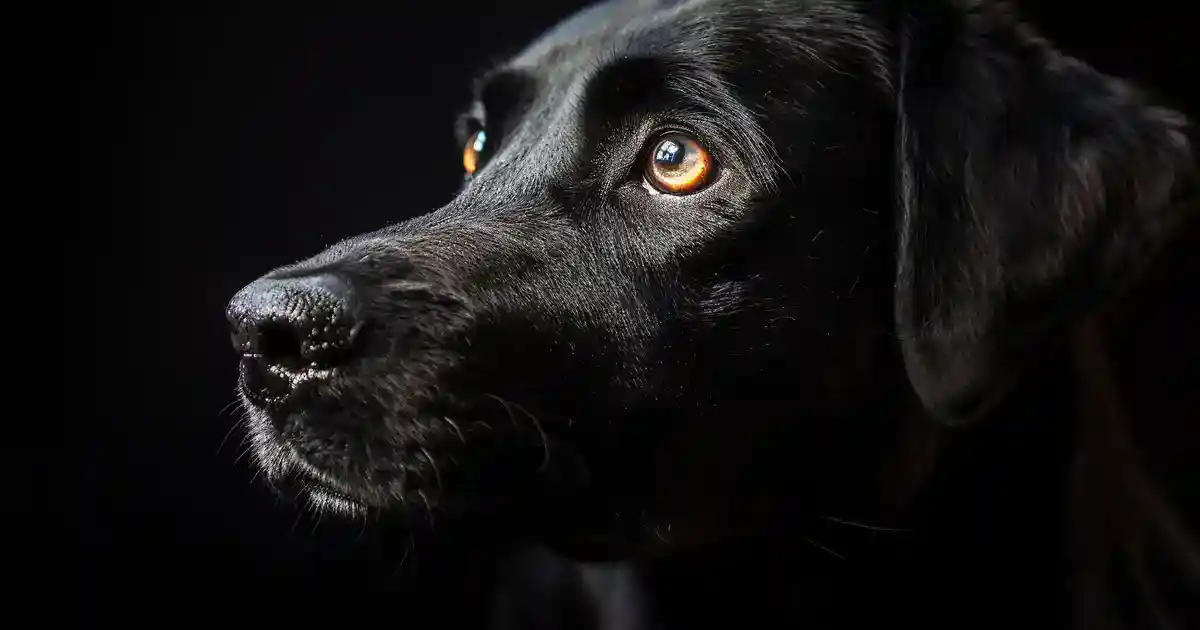
Have you ever wondered how your dog navigates perfectly through your dark house at night while you’re stumbling around looking for the light switch?
I totally get that amazed moment—you watch your dog confidently move through pitch-black rooms, catch toys in dim lighting, or spot movement in shadows that you can’t even detect, and you’re left wondering if dogs possess some kind of supernatural night vision. Here’s the thing I’ve learned after countless conversations with veterinary ophthalmologists and canine vision researchers: yes, dogs absolutely have superior night vision compared to humans, seeing roughly 5 times better in low-light conditions, but they don’t see in complete darkness and their nighttime vision works through specific biological adaptations rather than magical powers. The fascinating reality? Dogs’ eyes contain specialized structures—including more rod photoreceptors (light-sensitive cells), a reflective layer called the tapetum lucidum that amplifies available light, and larger pupils that gather more light—that evolved specifically to support crepuscular hunting (most active during dawn and dusk) when their wild ancestors needed to track prey in low-light conditions.
Now my clients constantly ask whether their dogs can see color at night, if night vision means dogs don’t need lights at all, and whether age or breed affects nighttime visual abilities. Trust me, if you’re curious about your dog’s sensory superpowers or you’ve been wondering whether leaving lights on actually helps your dog navigate at night, this comprehensive approach will show you exactly how canine night vision works, what limitations still exist, and how understanding your dog’s visual capabilities helps you create safer, more comfortable environments for nighttime activities and aging dogs with declining vision.
Here’s the Thing About Canine Visual Anatomy
Here’s what makes dogs’ eyes specially adapted for low-light vision—their retinas contain a dramatically higher ratio of rod photoreceptors to cone photoreceptors compared to humans (dogs have rod-dominant retinas while humans are more cone-dominant), and these rods are exquisitely sensitive to even tiny amounts of available light, allowing dogs to detect movement and shapes in lighting conditions that leave humans essentially blind. The magic lies in the tapetum lucidum, a mirror-like reflective layer behind the retina that bounces light back through the photoreceptors a second time, essentially giving each photon of light two chances to be detected and creating that characteristic glowing effect when light hits dogs’ eyes at night.
What I’ve discovered through working with veterinary ophthalmologists is that it’s honestly more sophisticated than most pet owners realize—the combination of rod dominance, tapetal reflection, larger pupils (which dilate more fully than human pupils to gather maximum available light), and a higher flicker fusion frequency (ability to detect rapid movement) creates a comprehensive low-light vision system perfectly suited for detecting prey, predators, and environmental hazards during twilight hours. According to research on mammalian vision and comparative ocular anatomy, these adaptations represent millions of years of evolutionary refinement for species that needed to function effectively during dawn and dusk when many prey animals are most active.
It’s a game-changing piece of information that transforms how you understand your dog’s behavior and needs—recognizing that dogs genuinely see better than you in dim conditions explains why they confidently navigate dark spaces, react to movements you can’t detect, and sometimes seem to stare at “nothing” in dark corners (they’re actually seeing subtle shadows or movements invisible to human eyes). This combination of anatomical and physiological adaptations creates genuine superior low-light vision, not supernatural abilities. No complicated equipment needed to test this—just observe your dog moving confidently through dim environments where you need a flashlight, and you’re witnessing evolutionary adaptation in action.
What You Need to Know – Let’s Break It Down
Understanding the specific eye structures that enable canine night vision requires examining each component and how they work together. First, let’s talk about rod photoreceptors—these specialized retinal cells detect light intensity and movement rather than color, and dogs possess dramatically more rods than humans (though exact ratios vary by breed). Don’t skip understanding this crucial difference (took me forever to realize this): the tradeoff for excellent night vision is reduced color perception, because rods don’t detect color wavelengths the way cone photoreceptors do, which is why dogs see a more limited color palette (primarily yellows and blues) compared to humans’ full-spectrum color vision.
The tapetum lucidum deserves special attention because it’s the single most important feature distinguishing dog vision from human vision. I finally figured out why dogs’ eyes glow in photographs or when light hits them at night—the tapetum reflects light back through the retina, giving photoreceptors a second opportunity to capture photons they might have missed on the first pass. (Game-changer for understanding that eerie eye-shine effect, seriously.) This reflective layer typically appears greenish, yellowish, or bluish depending on the angle and the individual dog, and it’s composed of zinc crystals or specialized cells arranged to maximize light reflection.
Here’s what really enhances low-light performance: pupil size and dilation capacity. Dogs’ pupils can dilate significantly larger than human pupils relative to eye size, creating a bigger “aperture” that gathers more available light in dark conditions. I always recommend understanding that pupil dilation is an automatic response controlled by the iris muscles—dogs don’t consciously control this, and it happens reflexively based on ambient light levels. When lighting is very dim, maximum pupil dilation combined with rod sensitivity and tapetal reflection creates the impressive night vision dogs are known for.
The positioning and field of view matters too. Dogs’ eyes are positioned more laterally (toward the sides) than human eyes, creating a wider total field of view (approximately 240-270 degrees compared to humans’ 180 degrees) that helps detect movement from peripheral areas. It’s honestly a survival advantage that allowed wild canids to spot approaching threats or fleeing prey from almost any direction. However, this wider field comes with reduced binocular overlap (the area both eyes see simultaneously), which slightly compromises depth perception compared to humans but provides superior motion detection.
If you’re just starting to understand how dogs perceive the world differently than humans, check out my complete guide to canine senses and perception for foundational knowledge on how dogs experience their environment through vision, hearing, smell, and other sensory systems that differ dramatically from human perception.
The Science and Evolution Behind Night Vision
The evolutionary biology of canine vision explains why these adaptations developed and how they serve wild canid survival strategies. Dogs descend from wolves and other wild canids that are crepuscular hunters—most active during twilight periods (dawn and dusk) when lighting conditions are challenging but many prey species are active and vulnerable. Research from comparative vision studies demonstrates that crepuscular predators consistently evolved similar adaptations: rod-dominant retinas for motion detection in dim light, tapeta lucida for light amplification, and dilating pupils for maximum light gathering during low-light hunting periods.
The photochemistry of rod cells involves rhodopsin, a light-sensitive pigment that undergoes a chemical change when struck by photons, triggering neural signals that the brain interprets as vision. What makes rods so sensitive is their ability to respond to even single photons under optimal conditions—though practical night vision requires more light than this theoretical minimum, the extreme sensitivity explains why dogs function well in lighting that seems nearly dark to humans. The rhodopsin regeneration process takes time (dark adaptation), which is why both humans and dogs need several minutes to adjust when moving from bright to dark environments, though dogs adapt more quickly and to lower light levels than humans.
From a neurological perspective, canine brains process visual information differently than human brains, with larger portions of the visual cortex dedicated to motion detection and peripheral awareness rather than fine detail and color discrimination. Understanding why behavioral responses occur—dogs react to subtle movements or shadows you can’t perceive because their visual system is literally wired to prioritize movement detection over detail recognition—helps owners appreciate that their dog’s reactions to “nothing” often reflect genuine sensory detection of stimuli invisible to humans.
The genetic basis of these adaptations varies somewhat across breeds, with some breeds retaining stronger low-light vision than others. Breeds developed for nocturnal hunting or guarding (like hounds or livestock guardian breeds) may have particularly well-developed night vision, while brachycephalic breeds with altered skull shapes sometimes have slightly different visual capabilities due to eye positioning changes. Individual variation exists within breeds too, just as human vision capabilities vary between individuals.
Here’s How Night Vision Actually Works in Practice
Start by understanding what “night vision” actually means for dogs—they need some ambient light to function, not complete pitch blackness. Here’s where I used to have misconceptions: I thought dogs could see perfectly in absolute darkness, like wearing night-vision goggles, but they actually need at least minimal light (moonlight, starlight, distant streetlights, or even very dim indoor lighting) for their visual system to function. Instead, think of canine night vision as extreme light amplification—they can use tiny amounts of light that seem like complete darkness to humans but actually contain enough photons for their highly sensitive eyes to detect shapes, movement, and spatial relationships.
Now for the important practical implications—in typical indoor nighttime conditions (ambient light from windows, electronics, distant streetlights), dogs navigate easily and confidently while humans struggle. Don’t be surprised when your dog moves through your dark house with perfect confidence; they’re genuinely seeing well enough to avoid obstacles, locate their bed, or find you in dark rooms. Here’s my observation from watching countless dogs: they move with purpose and accuracy in lighting that forces me to shuffle carefully with arms extended, confirming their superior low-light capabilities aren’t just about familiarity with the space.
The outdoor nighttime environment showcases these abilities even more dramatically. Until you experience walking your dog during new moon darkness, you might not fully appreciate the difference—while you struggle to see the path ahead, your dog confidently navigates, spots wildlife movement, and avoids obstacles that you literally cannot see. When you recognize your dog’s visual advantage, you’ll understand why they react to things in dark yards that you can’t detect and why they seem so comfortable during nighttime bathroom breaks that leave you feeling blind.
Limitations exist despite impressive capabilities. My mentor taught me this crucial principle: dogs still need some light, and they don’t see fine detail as well as humans even in good lighting. Every dog’s vision has its own characteristics, but generally, dogs sacrifice visual acuity (sharpness and detail) for motion sensitivity and low-light function. They excel at detecting movement but might not recognize a stationary person at the same distance where a moving person would be immediately obvious.
For dogs experiencing their environment primarily through vision, understanding that movement attracts attention more than static objects helps explain certain behaviors—why dogs react strongly to moving cats but might not notice the same cat when motionless, why thrown toys are easily tracked but dropped toys sometimes require scent to locate, and why hand signals work best when movements are large and distinct rather than subtle and detailed.
The aging factor matters significantly. Dogs experience age-related vision decline just like humans, including decreased night vision as rod function deteriorates, tapetal reflection becomes less efficient, and pupils dilate less fully. Continue monitoring your senior dog’s nighttime navigation confidence—decreased willingness to move through dark spaces, bumping into objects at night, or anxiety during evening walks may indicate declining night vision requiring environmental modifications like nightlights or increased outdoor lighting.
Common Mistakes (And What Owners Misunderstand About Dog Vision)
The biggest mistake I encounter constantly is people assuming dogs see perfectly in complete absolute darkness without any ambient light whatsoever. I used to think my dog had magical darkness-penetrating vision, not realizing he actually needed minimal light that was present from electronics, windows, or other sources I wasn’t consciously aware of. Don’t make this assumption—dogs need some photons to amplify, and in truly pitch-black environments (like caves, windowless rooms with doors closed, or deeply overcast moonless nights in remote areas), dogs struggle significantly more than in typical “dark” conditions that still contain minimal ambient light.
Another epic failure I’ve witnessed is people thinking the eye-shine reflection means dogs’ eyes are emitting light like flashlights. Wrong. The tapetum lucidum only reflects light back out of the eye—it doesn’t generate light. I’ve learned through optics explanations that when you see glowing dog eyes in photographs or when your flashlight catches them, you’re seeing light from your camera flash or flashlight bouncing back, not light the dog produced. This matters because it confirms dogs still need external light sources; their eyes just use available light much more efficiently than human eyes.
The “dogs see in black and white” misconception persists despite scientific evidence disproving it. People assume that because dogs have reduced color vision compared to humans, they see only grayscale. The reality is more nuanced—dogs are dichromatic (seeing two primary color dimensions: blue-violet and yellow), similar to humans with red-green colorblindness. I used to avoid colored toys thinking my dog couldn’t appreciate them, until I learned that blue and yellow objects actually show up quite vividly to dogs while reds and greens appear more muted or grayish. When I started choosing blue and yellow toys instead of red ones, my dog’s response and engagement noticeably improved.
Assuming night vision means dogs don’t benefit from lighting is a tactical error that can create safety issues. While dogs see better than us in dim conditions, additional lighting still improves their vision and makes navigation even easier and safer. I now provide nightlights in hallways and key rooms, not because my dog can’t navigate without them, but because better lighting reduces accident risks, helps aging dogs with declining vision, and provides backup if something unusual appears that requires detailed assessment rather than just motion detection.
The “perfect vision” assumption gets people in trouble when they don’t recognize individual variation or vision problems. Just like humans, dogs can develop cataracts, glaucoma, progressive retinal atrophy, and other eye conditions that degrade vision including night vision. Think about monitoring for vision decline rather than assuming your dog’s eyes will always function perfectly—early detection of eye problems allows earlier treatment and better outcomes. When I started observing for signs of vision changes (reluctance to navigate dark spaces, bumping into objects, dilated pupils that don’t constrict normally), I caught my senior dog’s early cataracts and discussed management options with my veterinarian before significant vision loss occurred.
When Vision Problems Affect Night Navigation
Finding out your dog has declining night vision or eye disease creates immediate concern about their safety and quality of life—that worried feeling hits every caring owner when their dog suddenly seems uncertain or anxious in conditions they previously handled confidently. You probably need to assess the situation carefully: has your dog’s nighttime navigation changed gradually or suddenly, are both eyes affected or just one, and are there other signs of eye problems like cloudiness, redness, discharge, squinting, or pupil abnormalities? That’s completely normal to feel concerned, and this situation requires veterinary examination to identify the underlying cause and appropriate interventions.
Don’t stress if your senior dog shows gradual night vision decline—age-related changes are common and manageable with environmental modifications. This is totally addressable through supportive strategies like installing nightlights in key areas (hallways, stairs, near pet beds), maintaining consistent furniture placement so your dog memorizes the layout, using baby gates to block dangerous areas like stairs, and increasing outdoor lighting for nighttime bathroom breaks.
I’ve learned to handle declining canine vision by staying proactive rather than reactive. When vision problems develop (and they eventually affect most senior dogs to some degree), your job becomes creating a safer environment that compensates for sensory decline. Most dogs adapt remarkably well to gradual vision loss because they rely heavily on scent and hearing, which typically remain strong even when vision fades.
For dogs experiencing sudden vision loss, preventing accidents requires immediate environmental management: block access to stairs with gates, pad sharp furniture corners, keep floor areas clear of obstacles, maintain extremely consistent household layouts (don’t rearrange furniture), and use verbal cues to guide your dog through unfamiliar spaces. If you’re noticing concerning vision changes, try scheduling a veterinary ophthalmology examination to determine whether the condition is treatable (cataracts can be surgically removed, some inflammatory conditions respond to medication) or requires adaptation strategies for permanent vision loss.
The technique veterinarians use involves comprehensive ophthalmic examination including visual response testing, pupillary light reflexes, intraocular pressure measurement (checking for glaucoma), slit-lamp examination (assessing internal eye structures), and sometimes advanced diagnostics like electroretinography to evaluate retinal function. When underlying conditions are identified early, treatment can often preserve remaining vision or slow progression, making proactive monitoring valuable rather than waiting until vision loss is severe.
Breed Differences and Night Vision Variations
Taking breed-specific visual adaptations into account helps you understand your particular dog’s likely capabilities and vulnerabilities. Advanced canine genetics and anatomy show specialized adaptations across different breed groups. Sighthounds (Greyhounds, Whippets, Salukis) developed for visually tracking prey over long distances have excellent motion detection and wider visual fields but may have less tapetal development than some other breeds. I discovered through comparative studies that their hunting style (chasing visible prey in open terrain) required different visual specializations than breeds that hunted in dense forests or at night.
For dogs bred for nocturnal work, night vision capabilities are often enhanced. Livestock guardian breeds (Great Pyrenees, Anatolian Shepherds) that protected flocks overnight, hounds used for nighttime hunting (Coonhounds, Bloodhounds), and breeds developed for guard work in low-light conditions often have particularly well-developed tapeta lucida and rod-dominant retinas. This extra optimization for low-light function makes these breeds especially adept at nighttime vigilance and navigation.
Brachycephalic breeds (short-nosed dogs like Bulldogs, Pugs, Boston Terriers) sometimes have altered visual capabilities due to their modified skull structure affecting eye positioning and shape. The more frontal eye placement can increase binocular overlap and improve depth perception but may slightly reduce peripheral vision compared to longer-snouted breeds. What separates understanding breed generalities from individual assessment is recognizing that these are tendencies rather than absolute rules—individual variation within breeds often exceeds variation between breeds.
Here’s what really matters for practical expectations: know your breed’s visual strengths and potential vulnerabilities. Breeds predisposed to certain eye conditions (Collies and progressive retinal atrophy, Cocker Spaniels and cataracts, Beagles and glaucoma) require more vigilant monitoring for vision problems that could affect their natural night vision capabilities. Timing preventive eye examinations based on breed-specific risks helps catch problems early when treatment is most effective.
Different coat colors around the eyes sometimes correlate with vision differences—dogs with heavy pigmentation around the eyes may have slight protection from bright light glare, while dogs with white or light-colored faces might be somewhat more sensitive to bright lights affecting dark adaptation. However, these differences are typically minor compared to the overall species-wide adaptations that make all dogs superior to humans at low-light vision.
Creating Vision-Friendly Environments for Your Dog
When you want to optimize your home and yard for your dog’s visual system, I use the Canine-Centered Lighting Protocol: provide adequate but not excessive indoor lighting that allows dogs to use their natural capabilities without over-reliance on bright lights, install nightlights in transitional areas (top and bottom of stairs, hallways, near doorways), use motion-activated outdoor lighting for nighttime bathroom areas, and avoid sudden bright lights in sleeping areas that can startle dogs and disrupt dark adaptation.
For dogs with declining vision, I love the Progressive Adaptation Method: gradually increase ambient lighting as vision declines rather than waiting until your dog struggles significantly, use contrasting colors to mark boundaries (dark rugs at the top of stairs so light-colored floors don’t create invisible edges), add textured mats in key locations to provide tactile cues, and use scent markers (different room sprays or essential oils in specific areas) to create multi-sensory navigation cues that compensate for reduced vision.
The Budget-Conscious Vision Support Method works beautifully with simple modifications: purchase inexpensive plug-in LED nightlights from discount stores ($2-5 each), use solar-powered path lights in the yard for free outdoor lighting, repurpose battery-powered closet lights for key indoor areas, and simply leave curtains slightly open at night to allow ambient outdoor light indoors. Sometimes I add reflective tape to furniture legs or edges that dogs might bump in darkness, though that’s totally optional and costs almost nothing.
For dogs experiencing normal vision changes with age, the Proactive Senior Care Approach includes: establish consistent routines so dogs know what to expect in different lighting conditions, maintain furniture placement religiously (moving the coffee table could cause collisions your senior dog with declining vision doesn’t see coming), increase verbal guidance and communication to supplement visual information, and schedule annual veterinary ophthalmology examinations after age 7 to catch age-related eye conditions early.
Why Understanding Night Vision Improves Dog Care
Unlike the assumption that dogs experience darkness the same way humans do, this approach leverages proven sensory biology knowledge that most pet owners completely overlook. The foundation is evidence-based: dogs’ visual systems evolved for different conditions and priorities than human vision, making them superior in low-light motion detection but inferior in color discrimination and fine detail, and these differences affect everything from toy selection to training methods to safety management.
What sets informed dog owners apart from those making assumptions is understanding that vision is just one component of the comprehensive sensory system dogs use to navigate their world—scent dominates dog perception in ways humans cannot fully comprehend, hearing detects frequencies and distances beyond human range, and vision, while important, ranks behind these other senses for most dogs in most situations. I discovered through sensory integration research that dogs rarely rely on vision alone, instead combining visual, olfactory, and auditory information to create complete environmental understanding.
The practical care principle matters too: environmental design should accommodate species-specific sensory capabilities rather than assuming dogs perceive the world identically to humans. This sustainable, science-based understanding means the question isn’t “how do I make my dog see like me?” but rather “how do I create spaces that work with my dog’s natural sensory strengths while supporting areas where they differ from humans?” Those are fundamentally different questions with very different design outcomes.
The training and behavior consideration resonates with thoughtful owners—many training challenges and behavioral issues stem from humans not recognizing sensory differences. When you understand that dogs rely heavily on motion detection and may not notice stationary objects, that they see blue and yellow most vividly, and that their peripheral vision exceeds yours dramatically, you can adapt training methods and environmental setups to work with their natural capabilities rather than against them.
Real Stories from Owners Discovering Night Vision
One client came to me amazed after watching her Border Collie catch a Frisbee in near-darkness during a late evening beach walk. Following her new understanding of canine night vision—the motion tracking abilities, light amplification from the tapetum, and superior low-light function—she realized her dog was genuinely seeing the flying disc clearly while she could barely discern it against the dark sky. What made this educational was her recognition that her dog’s abilities weren’t supernatural but rather the result of millions of years of evolutionary adaptation. The lesson? Your dog’s sensory capabilities often exceed your own in specific domains, and respecting these differences enhances appreciation for their unique perception.
Another pet parent shared their experience with an aging Labrador who gradually became anxious about nighttime activities she’d previously enjoyed. Their success aligns with research on age-related vision decline that shows night vision often deteriorates before daytime vision in senior dogs. They addressed the issue by installing outdoor path lighting, adding nightlights in the house, and maintaining extremely consistent furniture placement so their dog could navigate partly through memory even as vision declined. They credited environmental modifications with extending their dog’s confident mobility and independence through her senior years.
I’ve also encountered cases where owners initially didn’t recognize vision problems because their dogs compensated so effectively using scent and hearing. A Cocker Spaniel with progressive cataracts navigated familiar environments confidently through memorization and other senses, only revealing vision loss when introduced to completely novel environments in dim lighting. The lesson here opened owners’ eyes—dogs are remarkably adaptable and often mask sensory deficits until the problem becomes quite advanced, making proactive monitoring more important than waiting for obvious signs of struggle.
Different lifestyle patterns teach us important considerations too—urban dogs living in well-lit environments may never fully develop the night navigation confidence that rural dogs living where darkness is deeper and artificial light is limited demonstrate regularly. Being honest about how environmental lighting affects both human and canine nighttime function helps owners understand their dogs’ true capabilities versus reliance on artificial lighting that makes night vision less necessary.
Veterinary and Scientific Perspectives on Canine Vision
My personal experience working with board-certified veterinary ophthalmologists and vision researchers has revealed fascinating insights—while dogs’ low-light vision dramatically exceeds human capabilities, they sacrifice other visual dimensions (color perception, fine detail acuity, accommodation range) that humans prioritize. The veterinary ophthalmology literature documents these tradeoffs as evolutionary adaptations reflecting each species’ ecological niche and survival strategies.
For comprehensive canine vision information, I always recommend the American College of Veterinary Ophthalmologists’ client education resources and vision research published by comparative psychology departments at major universities. These authoritative sources provide the best scientifically accurate information about how dogs see, what visual capabilities and limitations they possess, and how eye diseases affect canine vision.
I’m particularly impressed with research using behavioral testing to quantify canine visual capabilities—studies where dogs demonstrate visual acuity by discriminating between patterns, experiments measuring color discrimination through training paradigms, and motion detection assessments that objectively measure the sensory capabilities we observe anecdotally. These studies provide the evidence base showing that the superior night vision dog owners observe isn’t imagination but measurable physiological reality grounded in anatomical adaptations.
The Canine Eye Registration Foundation (CERF), now part of the Orthopedic Foundation for Animals (OFA), maintains databases tracking hereditary eye diseases across breeds, helping breeders reduce genetic eye conditions through selective breeding. For detailed vision health guidance, veterinary ophthalmology textbooks and professional resources offer comprehensive information about eye anatomy, common diseases, and treatments that help owners understand when vision changes warrant professional attention.
Your Most Important Questions Answered
Can dogs see in complete darkness?
No—dogs need at least minimal ambient light to see. Their eyes amplify available light extremely efficiently through the tapetum lucidum and sensitive rod photoreceptors, allowing them to function in lighting that seems pitch-black to humans but actually contains tiny amounts of light from stars, moon, distant streetlights, or other sources. I usually tell curious owners that in truly absolute darkness (like a completely sealed room with zero light entering), dogs are essentially blind just like humans, though they’d rely on excellent scent and hearing to navigate instead.
How much better can dogs see at night compared to humans?
Dogs can see approximately 5 times better than humans in low-light conditions, though this varies somewhat based on the specific lighting level, the dog’s individual eye characteristics, and breed differences. This advantage comes from having more rod photoreceptors, a reflective tapetum lucidum, and larger pupils that gather more light. The difference becomes most noticeable in twilight or moonlit conditions where humans struggle while dogs navigate confidently.
Why do dogs’ eyes glow in the dark or in photographs?
The glow (called eyeshine) comes from the tapetum lucidum reflecting light back out of the eye. When external light (camera flash, flashlight, headlights) enters the eye, it passes through the retina, reflects off the tapetum, and exits the eye, creating that characteristic glowing appearance. This same reflective property helps dogs see better at night by giving photoreceptors a second chance to capture incoming light. The color varies (green, yellow, blue, orange) based on tapetal structure, viewing angle, and individual variation.
Do all dog breeds have the same night vision capabilities?
While all dogs have superior night vision compared to humans, some breed differences exist. Breeds developed for nocturnal work (guarding, hunting at night) may have particularly well-developed night vision, while brachycephalic breeds with altered skull shapes might have slightly different visual capabilities due to eye positioning changes. However, individual variation within breeds often exceeds variation between breeds, making it difficult to predict exact capabilities based solely on breed.
Can dogs see colors at night?
Color vision relies primarily on cone photoreceptors, which require more light than rods to function. In very low light conditions, even dogs primarily use rod-based vision, making nighttime vision mostly achromatic (lacking vivid color). Dogs see limited color (blue-yellow spectrum) even in good lighting, so nighttime color perception is minimal at best. They’re detecting primarily light intensity, movement, and shapes rather than colors during low-light conditions.
Do puppies have night vision from birth?
Puppies are born with their eyes closed and don’t develop functional vision until around 2-3 weeks of age. Once eyes open and vision develops, puppies gradually develop the full range of canine visual capabilities including night vision as their eye structures mature. By several months of age, puppies should have adult-level low-light vision capabilities, though very young puppies might be somewhat less confident navigating dark environments simply due to inexperience rather than visual limitations.
Should I leave lights on for my dog at night?
It depends on your dog’s individual needs and your household setup. Dogs with normal vision can navigate typical indoor darkness easily and don’t require lights, but nightlights in key areas (stairs, hallways) provide extra safety margins, help senior dogs with declining vision, and make everyone more comfortable. There’s no harm in providing ambient lighting, and it might prevent accidents even though dogs theoretically don’t need it.
How can I tell if my dog’s night vision is declining?
Watch for behavioral changes including reluctance to go outside after dark, hesitation at stairs or doorways in dim lighting, bumping into furniture at night (especially furniture that was recently moved), increased anxiety during evening walks, dilated pupils that don’t constrict appropriately in brighter light, and cloudiness or other visible changes to the eyes themselves. Any of these signs warrants veterinary examination to assess vision and identify potential eye diseases requiring treatment.
Are certain eye colors associated with better night vision?
Eye color refers to iris pigmentation and doesn’t directly affect night vision capabilities, which depend on retinal structure (rod density, tapetum lucidum) rather than iris color. However, the underlying genetics that influence coat and eye color sometimes correlate with other traits, and some very pale or albino animals might have less functional tapeta or photoreceptor abnormalities. For typical dogs with normal eye pigmentation (brown, amber, blue), night vision capabilities are similar regardless of iris color.
Can eye diseases affect dogs’ night vision specifically?
Yes—conditions affecting rod photoreceptors or the tapetum can specifically impair night vision before daytime vision declines. Progressive retinal atrophy often causes night blindness as an early symptom because rods degenerate before cones in many forms of PRA. Cataracts can scatter incoming light, reducing the effectiveness of the tapetum and compromising low-light vision. Any condition causing pupil dysfunction or corneal opacity may disproportionately affect night vision by reducing light transmission into the eye.
Do dogs need UV protection for their eyes like humans do?
Dogs’ eyes contain protective mechanisms against UV damage including pigmentation and filtering within the lens. However, excessive UV exposure can contribute to cataract development over time. Dogs spending extensive time in bright sunlight or high-altitude environments with intense UV radiation might benefit from eye protection (doggie goggles), particularly breeds predisposed to eye conditions. Most dogs don’t require routine UV eye protection, but discuss individual risk factors with your veterinarian.
How does night vision compare between dogs and cats?
Cats have even better night vision than dogs, seeing approximately 6-8 times better than humans in low light compared to dogs’ 5-fold advantage. Cats have an even higher rod-to-cone ratio, larger eyes relative to head size, and elliptical pupils that open more widely than round pupils. Both species have tapeta lucida, though cats’ are often more reflective. These differences reflect cats’ evolution as nocturnal solitary hunters versus dogs’ crepuscular pack-hunting ancestry.
Appreciating Your Dog’s Visual Superpowers
I couldn’t resist sharing this because it proves that understanding species differences deepens appreciation for your dog’s unique capabilities—you don’t need to anthropomorphize your dog or assume they perceive the world identically to you to develop a strong bond; in fact, recognizing and respecting their different sensory strengths creates even more meaningful connection and communication. The best dog care happens when owners learn about canine sensory systems, accommodate species-specific needs, and design environments that work with natural capabilities rather than against them. Ready to optimize your dog’s visual environment and safety? Start by observing how confidently your dog navigates different lighting conditions to understand their individual capabilities, install nightlights in key areas to support aging dogs or provide extra safety margins, choose blue and yellow toys for maximum visibility based on canine color vision, and schedule regular veterinary eye examinations to catch vision problems early when they’re most treatable. Your first critical step is shifting from “my dog should see like me” to “how does my dog actually see, and how can I support their natural visual system?”—because that perspective transformation creates better care, safer environments, and deeper appreciation for the remarkable evolutionary adaptations that make your dog uniquely capable in their own way!




